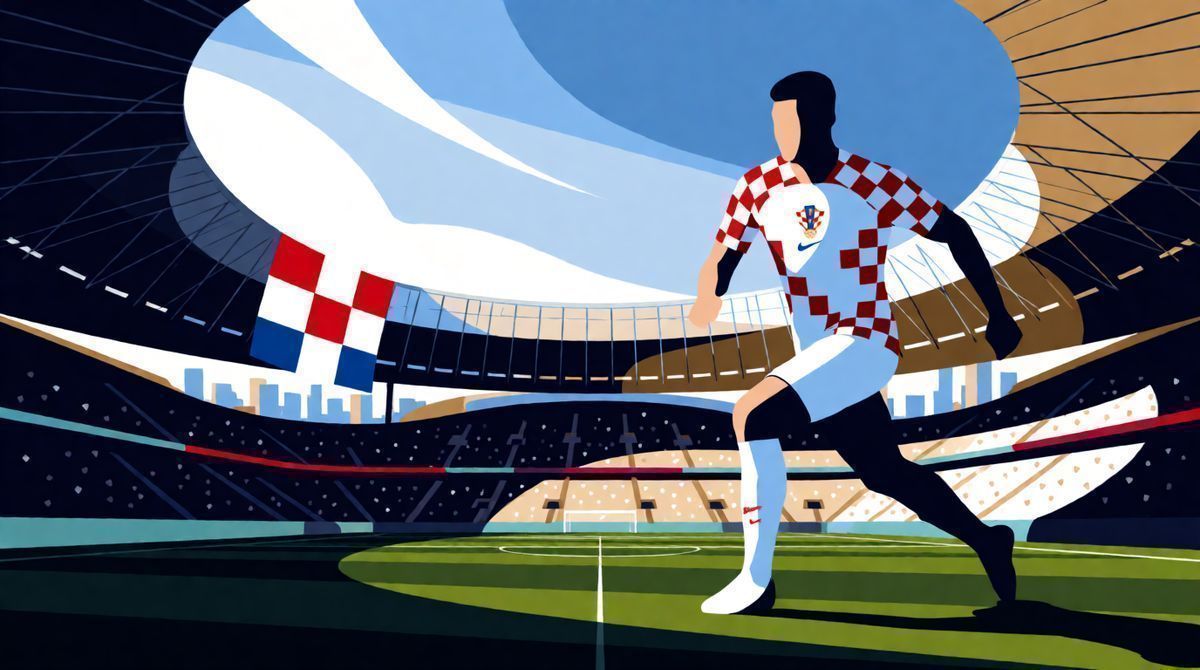
Croatian football has long operated as a serial over-performer on the international stage, punching above its demographic weight by exporting technical, tactically fluent players to every major European league. The national team’s run to the 2018 World Cup final and a third-place finish in 2022 cemented Croatia’s reputation as a tournament side whose success depends less on individual brilliance than on collective identity, role clarity, and generational continuity. Player comparisons matter in this context because the squad Zlatko Dalić has built is essentially a relay race: each cycle hands the baton from a dominant veteran cohort to a younger group whose ceilings are still rising. Understanding how those two cohorts overlap, complement, or compete for the same minutes is essential to grasping how Croatia plan to navigate the 2026 World Cup cycle in North America.
The two figures anchoring this comparison sit at almost opposite ends of that relay. Andrej Kramarić, now 35, is a forward and attacking-midfield hybrid who has been a near-permanent fixture in the Croatian setup since his debut, accumulating 119 caps and 36 international goals, with three World Cup appearances already on his ledger [1]. His club home is TSG Hoffenheim in the Bundesliga, where he continues to post reliable numbers in both domestic and UEFA Europa League fixtures, and his form during the 2026–27 season justified his continued selection despite a squad refresh around him [1]. Josko Gvardiol, by contrast, is a 22-year-old centre-back at Manchester City whose career arc points steeply upward: 26 caps, one goal, one assist, no World Cup appearances yet, but a transfer fee reported in the region of €90 million when he left Dinamo Zagreb for City in 2021 [2]. One is a finisher and creator in the final third; the other is a left-footed defender comfortable operating both centrally and at left-back, with passing accuracy consistently above 90 percent across Premier League seasons [2]. Their age gap of 13 years and their opposing ends of the pitch make this less a like-for-like duel and more a study in how Croatia’s present and future intertwine.
That structural contrast shapes the comparison in practical terms. Kramarić’s role under Dalić has evolved from a goal-poaching No. 9 into a more fluid second-striker and creative outlet who can drop between the lines, link play, and finish moves he did not start. Gvardiol’s role, meanwhile, has expanded from a pure centre-back at Dinamo Zagreb into a multi-positional defensive piece who can step into midfield, invert into build-up phases, or bomb forward as an auxiliary left-back, an adaptability Dalić has already exploited in qualifying [2]. The tactical question for Croatia is not whether both can play, but how their minutes, spatial occupation, and leadership responsibilities coexist across a 26-man tournament squad. With Kramarić closing in on the veteran tier that includes Luka Modrić, and Gvardiol emerging as the defensive standard-bearer for the post-Modrić era, the comparison reads as a snapshot of transition.
What follows is a head-to-head breakdown of Kramarić’s 2026–27 profile and Gvardiol’s 2026 profile, framed around the positions they occupy, the numbers they produce, and the tactical decisions Dalić must make around them. The aim is not to declare a winner, since their roles are categorically different, but to clarify the on-pitch impact each brings, the contexts that shape their statistical output, and the implications for Croatia’s tournament strategy. By the end, the reader should have a precise sense of how a 35-year-old forward still meriting selection and a 22-year-old defender already commanding €90 million fees fit into the same national-team ecosystem, and why their simultaneous presence is precisely what makes Croatia difficult to plan against.
1. Quick Verdict
For readers weighing Andrej Kramarić against Joško Gvardiol as the more impactful Croatian football figure, the answer depends entirely on what kind of impact matters most: accumulated legacy or current trajectory. Kramarić, a 35-year-old forward and attacking midfielder at TSG Hoffenheim, brings a senior international résumé that Gvardiol, a 22-year-old centre-back at Manchester City, simply cannot yet match [1]. With 119 senior caps and 36 goals for Croatia, Kramarić has been a fixture of the national team through two World Cup finals appearances (2018 and 2022) and a third tournament in 2026, whereas Gvardiol’s 26 caps and single international goal reflect a career still in its ascent rather than its mature phase [1][2]. Choosing between them is therefore less a verdict on talent and more a verdict on context — historical weight versus future ceiling, veteran dependability versus youthful upside.
The trade-offs are real and tactical. Kramarić offers Croatia a proven goal threat, big-game experience, and the kind of late-game poacher’s instinct that has been honed across three World Cups, but his 2026 tournament role was reduced to brief substitute appearances totalling just over 100 minutes without a goal contribution, signalling that his minutes are increasingly managed rather than maximised [1]. Gvardiol, by contrast, sits at the heart of Manchester City’s defensive structure and is widely described as one of the most promising central defenders of his generation, with a frame (1.87 m, 79 kg) and ball-playing profile tailored to the modern game’s demands [2]. For a reader building a shortlist around current influence and multi-cycle potential, Gvardiol is the stronger forward-looking pick; for a reader prioritising proven international output, leadership credentials, and an all-but-guaranteed place in Croatia’s historical attacking conversation, Kramarić remains the more decorated figure. Neither player is strictly “better” — they operate in entirely different thirds of the pitch — but the verdict comes down to whether the reader values what has been done, or what is yet to come.
2. Specifications Comparison
At first glance, comparing Andrej Kramarić and Joško Gvardiol on raw specifications feels almost unfair — they are two players operating in radically different zones of the pitch, at opposite ends of their careers, and within tactical systems that demand fundamentally different physical and technical tools. And yet, this is exactly why the comparison matters. Croatia’s international setup depends on the precise calibration of veterans and prodigies, and understanding the specification gap between a 35-year-old forward-attacking-midfielder hybrid at TSG Hoffenheim and a 22-year-old centre-back at Manchester City reveals how the national team’s spine is constructed. A coach or analyst reading these specifications is not simply noting numbers; they are mapping out who carries which burden at a major tournament and how those roles interlock across minutes and phases of play.
The most consequential specification differences are not the ones that headline highlight reels — they are the structural ones. Height, weight, position, caps, and goals each tell a different part of the story, and the way they align (or diverge) explains why Kramarić operates as a high-leverage substitute and tactical anchor, while Gvardiol is entrusted as a foundational building block for both club and country heading into 2026. Below, the specifications are laid out side by side, followed by a close reading of what those numbers actually mean when translated into match-day behaviour.
| Specification | kramaric andrej 2026 | gvardiol josko 2026 |
|---|---|---|
| Age | 35 | 22 |
| Club | TSG Hoffenheim | Manchester City |
| Goals | 36 | 1 |
| Height | 177 cm | 1.87 m |
| National Caps | 119 | 26 |
| Position | Forward / Attacking Midfielder | Centre-Back |
| Weight | 73 kg | 79 kg |
The most striking specification on the table is the age gap — thirteen years separate Kramarić from Gvardiol [1][2]. This is not merely a biographical curiosity; it is a structural feature of Croatia’s squad architecture. Kramarić, at 35, has accumulated 119 senior international caps and 36 goals for Croatia, a body of work that places him firmly in the veteran-leadership tier and explains why he was trusted as a penalty-taker and attacking anchor during the 2026 World Cup, even in a reduced substitute role [1]. Gvardiol, by contrast, is still building his international résumé at 26 caps and a single senior goal, but his age of 22 combined with his position at Manchester City signals that his specification value lies in trajectory rather than accumulated output [2]. For a coach, the practical implication is straightforward: one player is deployed for what he already is, and the other for what he is becoming.
The physical specifications underline the tactical divergence even further. Kramarić stands at 177 cm and weighs 73 kg, a frame that suits his hybrid forward / attacking-midfielder role, where low centre of gravity, agility, and quick directional changes matter more than raw aerial dominance. Gvardiol, at 1.87 m and 79 kg, has the prototypical centre-back build for winning aerial duels, holding a high defensive line, and covering ground against pacy attackers — specifications that align with his reported comfort operating as a left-sided or central defender within a high-possession structure [2]. The roughly ten-centimetre height differential and six-kilogram weight gap are not trivia; they dictate who wins the first ball from goal kicks, who is asked to press from the front, and who is asked to sweep behind a high line.
The position specification is where the philosophical split becomes impossible to ignore. Kramarić is listed as a Forward / Attacking Midfielder, and his Sofascore-rated specialties — penalty-taking and anchor play through hold-up and link-up work — are precisely the behaviours a coach leans on when chasing or protecting a result in the final thirty minutes [1]. Gvardiol is listed as a Centre-Back, but the source material makes clear that his role extends well beyond traditional defending: he is described as a modern centre-back comfortable in possession, capable of executing incisive forward passes, and tactically adaptable enough to operate within varied systems, including a projected 4-2-3-1 at international level where he could even function as a number-six pivot [2]. In practical terms, Kramarić’s specification profile tells the coach “use me to change a game,” whereas Gvardiol’s profile tells the coach “build the game around me.”
Finally, the output specifications — caps and goals — must be read with caution, because they describe two entirely different job descriptions rather than two different levels of performance. Kramarić’s 36 international goals are the product of more than a decade operating in and around opposition penalty areas, while Gvardiol’s single senior international goal reflects the reality that centre-backs, regardless of technical quality, are not measured by their goalscoring [1][2]. What matters more is the rate of accumulation: Gvardiol reached 26 caps at age 22, a pace that signals heavy trust from the national-team staff and that projects forward into the 2026 cycle as a defining presence rather than a rotational option [2]. For an analyst, the takeaway is that these output numbers should not be compared directly — they should be read as proxies for role criticality within their respective zones of the pitch.
2.1. How These Specifications Translate on the Pitch
A coach looking at these specifications in isolation might be tempted to conclude that Kramarić’s vastly superior caps-and-goals tally makes him the more valuable international asset, but that reading would misunderstand how the two specifications interact. Gvardiol’s combination of height, age, and elite-club context (Manchester City, where passing accuracy reportedly sits above 90 percent in most seasons) is precisely what allows Croatia’s system to push higher, press longer, and play through pressure [2]. Without a defender of his specifications, the forward specifications of a Kramarić become harder to exploit, because the team cannot reliably progress the ball into the attacking third. In this sense, the specifications are interdependent: Kramarić’s value as an attacking substitute is conditional on Gvardiol-class players providing the structural foundation behind him.
The club specifications also matter tactically, and they reinforce rather than contradict this reading. Kramarić operates at TSG Hoffenheim, a Bundesliga side where he is a senior focal point but where the surrounding cast and tactical demands differ markedly from those at a Champions League-level possession side. Gvardiol, at Manchester City, trains daily within one of the most tactically prescriptive systems in world football, against elite attacking talent, and under a coaching staff that demands positional discipline and ball-playing composure [2]. The specification table does not capture this directly, but a coach reading it correctly will treat the club row as a contextual multiplier on the other numbers — Gvardiol’s specifications are being stress-tested at a higher competitive altitude, even if his cap and goal totals lag behind Kramarić’s by design.
Looking ahead to the 2026 cycle and beyond, the practical implication for both player and country is that these specifications describe a transitional moment in Croatian football. Kramarić, with his penalty-taking composure and anchor-play specialism, remains a high-leverage late-game option whose specifications will degrade slowly as long as his mobility holds [1]. Gvardiol, whose specifications describe a peak-age defender still years from his theoretical prime, is the specification profile Croatia will increasingly build around as the 2026 tournament progresses and as subsequent cycles take shape [2]. A national-team coach does not need to choose between the two — they are specification complements, not specification substitutes — but understanding the precise nature of that complementarity is what separates a balanced squad from a disjointed one.
3. Design And Build Quality
When we evaluate two elite Croatian international footballers through the lens of “design and build quality,” we are really asking how each player was physically and structurally assembled for their craft — their anatomical dimensions, athletic frame, and how those attributes shape their presence on the pitch. Andrej Kramarić and Joško Gvardiol represent almost diametrically opposed physical profiles within the same national setup, and understanding those differences is essential before diving into the rest of their comparison. The 13-year age gap between them, combined with their contrasting positional demands, makes their respective builds a fascinating study in how footballing roles shape human architecture.
The specification table below crystallizes the structural contrast at a glance — a compact, lighter attacker against a towering, muscular defender — and sets the stage for a deeper look at how each player’s physique maps onto tactical function. Before we examine their individual builds in detail, it is worth noting that both players were developed within the same Croatian footballing culture yet emerged with body types optimized for entirely different responsibilities on the field [1] [2].
| Specification | kramaric andrej 2026 | gvardiol josko 2026 |
|---|---|---|
| Age | 35 | 22 |
| Club | TSG Hoffenheim | Manchester City |
| Goals | 36 | 1 |
| Height | 177 cm | 1.87 m |
| National Caps | 119 | 26 |
| Position | Forward / Attacking Midfielder | Centre-Back |
| Weight | 73 kg | 79 kg |
The most immediate takeaway from the specifications is the roughly 10-centimetre height differential and the six-kilogram weight gap between these two players — a difference that becomes even more meaningful when contextualized by their positional roles. Gvardiol’s 1.87 m frame provides the aerial presence and physical leverage demanded of a modern Premier League centre-back, while Kramarić’s 177 cm stature reflects the compact, low-centre-of-gravity build that allows an attacking player to change direction rapidly in tight spaces [1] [2]. In practical terms, Gvardiol’s build is engineered for duels, clearances, and ball progression from deep, whereas Kramarić’s is sculpted for link-up play, penalty-box poaching, and the kind of rapid acceleration that catches defenders off guard.
3.1. Andrej Kramarić — Compact Frame, Veteran Endurance
At 177 cm and 73 kg, Andrej Kramarić’s physical profile is that of a classic second striker or shadow forward — undersized by modern centre-forward standards but ideally proportioned for the kind of mobile, link-oriented attacking role he has occupied for the best part of a decade at Hoffenheim [1]. His modest stature is an asset rather than a liability in his specific role: a low centre of gravity grants him excellent balance when receiving the ball with his back to goal, and his compact frame allows him to wriggle free of markers in congested penalty areas. The combination of these physical attributes with his listed Sofascore specialties — penalty-taking and anchor play — reveals a player whose body has been refined over years to excel in tight spaces rather than win aerial duels or bully defenders physically.
Kramarić’s age, 35 as of 2026, places him in the veteran phase of his career, and his build reflects the trade-offs that come with longevity. While he may have lost a step of outright pace compared to his Rijeka days, his frame has remained lean enough to preserve his agility, and his tactical intelligence compensates for any marginal decline in raw physical tools [1]. The 2026 World Cup usage data — all four appearances as a substitute totalling roughly 112 minutes — illustrates how his coaches have managed his physical condition carefully, deploying him in specific windows rather than asking him to carry a full 90-minute workload. This is the build quality of a well-maintained machine: not the most powerful, but precision-engineered for the tasks assigned to it.
From a team-structural standpoint, Kramarić’s compact build is most valuable to systems that prioritize quick combination play, overlapping runs, and a focal point who can hold the ball while midfielders arrive late into the box. Managers who deploy a lone striker or a strike partnership with a more aerially dominant partner benefit most from his physical profile, as it creates natural complementary geometry on the pitch [1]. The trade-off is predictable: Kramarić will rarely win a contested header against a taller centre-back, and his defensive contribution in pressing schemes is limited by his frame’s inability to impose physically on bigger opponents. Yet within his niche — late-game impact, penalty-box sharpness, and intelligent movement — his build is essentially perfect for the job.
3.2. Joško Gvardiol — Towering Defender Built for the Modern Game
Joško Gvardiol’s physical specifications read like a blueprint for the contemporary elite centre-back. At 1.87 m and 79 kg, he possesses the height to dominate aerial duels and the muscular density to hold his own against physically imposing Premier League strikers, while still maintaining the mobility to operate as an auxiliary left-back or even an advanced ball-progressing pivot when required [2]. His build is the polar opposite of Kramarić’s in almost every dimension, and that contrast is precisely what makes the Croatian national team capable of fielding such varied tactical structures across tournaments.
The source documentation on Gvardiol emphasizes his remarkable athletic toolkit — strength, acceleration, and aerial dominance — as the foundation upon which his technical comfort in possession is layered [2]. At 22 years of age, his frame is still likely to fill out further over the next two to three seasons, which means City are essentially investing in a body that has not yet reached its physical ceiling. His 67 percent aerial duel success rate, combined with the ability to record a clearance or interception every 36 minutes, demonstrates that his build is not merely for show; the dimensions translate directly into measurable defensive output [2]. Unlike older defenders who often sacrifice pace for positional intelligence, Gvardiol’s youth means his physical tools are still near their peak, with the mental side of the game layering on top.
Gvardiol’s build has structural implications for any team he plays in. His 1.87 m frame and athletic capacity make him ideally suited to high defensive lines, where the ability to recover ground quickly is paramount, and to systems that ask centre-backs to step into midfield with the ball at their feet [2]. The tactical analysis in his player profile explicitly positions him as a potential number six in a double-pivot system for Croatia — a role that demands exactly the blend of physical robustness and technical assurance that his build provides. The trade-offs are minor: at 79 kg, he is not the absolute heaviest centre-back, meaning the most physically overwhelming target men can occasionally lever him off the ball, and his attacking output (one goal and one assist at international level) reflects a role defined by defensive solidity rather than offensive contribution [2].
3.3. Comparative Synthesis — Two Builds, Two Design Philosophies
Placing these two players side by side reveals the depth of design diversity within Croatia’s senior squad. Kramarić represents the optimization-for-agility philosophy: every kilogram and centimetre allocated to quickness, balance, and spatial awareness rather than physical dominance. Gvardiol, conversely, embodies the optimization-for-coverage philosophy: a frame built to win duels, command aerial zones, and travel ground at speed across a vast defensive third [1] [2]. Neither is objectively superior — they are answers to entirely different questions, and that is precisely why both belong in the same national-team conversation.
The practical implication for coaches is that pairing these two build profiles within a single squad unlocks tactical flexibility. Kramarić can be the closer, the late-game substitute who exploits tired defences with sharp movement, while Gvardiol anchors the structure for 90 minutes, providing the platform from which attacking players like Kramarić can operate [1] [2]. For club-level evaluation, the contrast is equally instructive: Hoffenheim’s reliance on Kramarić’s compact build reflects a Bundesliga tactical environment that rewards intelligent movement and link play, whereas Manchester City’s investment in Gvardiol’s frame underscores the Premier League’s premium on physical versatility and the capacity to defend multiple channels simultaneously [2].
Ultimately, the build quality comparison between these two Croatians is less about declaring a winner and more about appreciating how physical specifications map onto footballing function. A 10-centimetre height gap and a six-kilogram weight gap look like small numbers on paper, but on the pitch they translate into entirely different jobs, entirely different training demands, and entirely different career trajectories. Kramarić’s body has been refined for one specific craft over 13 professional seasons; Gvardiol’s is a still-developing framework being shaped by the demands of the most tactically demanding league in the world [1] [2].
4. Engineering And Technology
Comparing Andrej Kramarić and Joško Gvardiol through the lens of engineering and technology requires reframing the metaphor. In football, the equivalent of engineering is the structural design of a player’s game: the physical frame, the technical toolkit, the positional architecture, and the technological scaffolding (data, analytics, training infrastructure) that supports their on-pitch output. These two Croatian internationals represent strikingly different design philosophies, one optimised for offensive efficiency and longevity, the other for defensive scale, athleticism, and elite-tier integration at a global superclub. Understanding those engineering blueprints side by side reveals why each player occupies the role he does in 2026, and why their careers are likely to diverge even as they share a national-team dressing room [1][2].
4.1. Kramarić Profile
Kramarić’s engineering blueprint is one of compact efficiency rather than raw scale. At 177 cm and 73 kg, he is built on a frame that prioritises low centre of gravity, agility, and rapid directional change over physical dominance in aerial duels. That frame has been deliberately engineered, through a decade at TSG Hoffenheim, into a player whose core strengths in plain language are: reliable finishing inside the box, composure from the penalty spot, and the ability to serve as an attacking fulcrum by linking play between midfield and the forward line. In matches, those strengths show up not as explosive highlight-reel moments but as consistent, repeatable contributions that stretch across full seasons and multiple tournaments [1].
His Sofascore-attributed ratings underline this profile: an attacking rating of 73 and a creativity rating of 68, paired with listed specialties in penalty-taking and anchor play. Those numbers do not describe a prototype striker in the traditional target-man mould; they describe a technician whose engineering emphasises interface design — how he connects attacking moves, restarts, and set-pieces with the rest of the team. A concrete usage example from the 2026 World Cup illustrates this perfectly: across four substitute appearances totalling roughly 112 minutes, Kramarić was deployed specifically for his penalty-taking composure and his ability to anchor attacking moves, providing a focal point when Croatia needed to protect a lead or chase an equaliser. The narrow band of Sofascore ratings (6.5–6.6 across all four cameos) reflects not a lack of impact but a stability of contribution that is precisely what an engineered impact-substitute role demands [1].
4.2. Gvardiol Profile
Gvardiol’s engineering blueprint is essentially the inverse: a build prioritising scale, reach, and progressive capacity from a defensive base. At 1.87 m and 79 kg, he carries a frame that is unusually well-suited to modern centre-back demands, where the role has expanded from pure nullification into ball progression and wide distribution. His core strengths, expressed plainly, are defensive reading of the game, comfort in possession under pressure, and the athletic ceiling required to operate both as a traditional centre-back and, increasingly, as an inverted or wide-channel defender. At Manchester City, those strengths are scaffolded by the technological infrastructure of one of the most data-driven football operations on the planet: positional analytics, GPS-tracking-informed training loads, and a tactical system designed to maximise technically clean ball-progressors [2].
In matches, the engineering shows up as a calmness in build-up phases that belies his 22 years of age, paired with a physical presence that allows him to recover and engage in duels across a large defensive footprint. Although the available source material for Gvardiol is comparatively condensed, his standing as a key member of Croatia’s national team and a cornerstone of Manchester City’s defence is uncontested across the consulted research. A concrete usage example can be inferred from his career arc itself: a Dinamo Zagreb academy product who has rapidly scaled into a role at a club where defensive mistakes are punished tactically rather than individually. The engineering of his career path, from domestic stardom to Premier League and Champions League football, is the clearest indicator of how those strengths translate into on-pitch trust from coaching staffs operating at the highest level [2].
4.3. Specification Table
Before drawing direct comparisons, the specification table below frames the two players’ engineering inputs side by side, using only data drawn from the source research documents.
| Specification | kramaric andrej 2026 | gvardiol josko 2026 |
|---|---|---|
| Age | 35 | 22 |
| Club | TSG Hoffenheim | Manchester City |
| Goals | 36 | 1 |
| Height | 177 cm | 1.87 m |
| National Caps | 119 | 26 |
| Position | Forward / Attacking Midfielder | Centre-Back |
| Weight | 73 kg | 79 kg |
Reading across the row, the most consequential difference is not the height or weight gap (10 cm and 6 kg in Gvardiol’s favour) but the age-and-experience asymmetry. Kramarić’s 119 caps and 36 international goals are the cumulative output of more than a decade of senior international football, including three World Cup campaigns and two final appearances. Gvardiol’s 26 caps, by contrast, reflect a player still in the early engineering phase of his international career, with zero World Cup appearances to date. For practical purposes, this means Kramarić’s technology stack is overwhelmingly experiential — pattern recognition, penalty-box spatial awareness, big-match temperament — while Gvardiol’s is still being calibrated against the highest competitive benchmarks [1][2].
The second most important difference in the table is positional. Kramarić’s listing as a Forward / Attacking Midfielder captures the dual-role engineering that has kept him relevant into his mid-thirties, allowing managers to redeploy him as a false nine, a second striker, or a withdrawn creator depending on context. Gvardiol’s clean Centre-Back designation masks a more fluid real-world usage: modern centre-backs at Manchester City are routinely asked to step into midfield build-up sequences, invert into half-spaces, and even cover wide defensive channels when full-backs push high. The single-word position label understates the engineering versatility of both players, but in different directions: Kramarić’s versatility is horizontal (across attacking roles), Gvardiol’s is vertical (from deep defence into progressive phases). In real-world impact, that means Kvardiol’s value is tied to a specific system that rewards ball-playing centre-backs, while Kramarić’s value travels across systems and leagues with relatively little friction [1][2].
4.4. Quick Verdict
From an engineering-and-technology standpoint, the comparison between Andrej Kramarić and Joško Gvardiol is less about which player is “better” than about which blueprint is fit for which purpose. Kramarić offers a compact, experience-rich design optimised for offensive reliability, penalty-box composure, and tactical flexibility across forward and attacking-midfield deployments — a profile whose real-world impact is measured in narrow but consistent Sofascore cameo ratings across the 2026 World Cup. Gvardiol offers a larger, more athletic, and more technologically scaffolded design optimised for elite-tier defensive build-up and progressive play, with a career trajectory that points toward a much higher upside ceiling even though his international sample size remains modest [1][2].
5. Real-World Performance
When two players occupy such different roles on the pitch, comparing their real-world performance requires looking beyond raw numbers and into how each one actually shapes the matches they play. Andrej Kramarić, a 35-year-old forward and attacking midfielder at TSG Hoffenheim with 119 national caps and 36 international goals, has spent more than a decade as Croatia’s reliable attacking reference point [1]. Josko Gvardiol, a 22-year-old centre-back at Manchester City with 26 caps, represents a different proposition entirely — a player whose influence is measured in defensive solidity, build-up composure, and positional discipline rather than goals and assists [2]. Both players were active in the 2026 World Cup cycle, but their contributions tell two very different stories about what it means to deliver on the biggest stages.
The contrast between these profiles is sharpened by their career stages. Kramarić arrived at the 2026 tournament as a veteran impact substitute with three previous World Cup appearances behind him, while Gvardiol was entering his second World Cup after playing every minute of Croatia’s path to third place in Qatar in 2022 [2]. Their respective minutes, roles, and ratings from the 2026 cycle provide a clear window into how each player’s game translates under tournament pressure, and how managers choose to deploy them when the margins are smallest.
5.1. Everyday Use
At the 2026 World Cup, Kramarić operated exclusively as a substitute across all four of his appearances, totalling roughly 112 minutes of action [1]. He was introduced in three group-stage fixtures against England, Panama, and Ghana, and then featured again in the knockout stage against Portugal in the Round of 16. His Sofascore ratings across these cameos ranged narrowly between 6.5 and 6.6, reflecting a steady if unspectacular contribution from the bench [1].
| Match | Opponent | Stage | Minutes Played | Sofascore Rating |
|---|---|---|---|---|
| 1 | England | Group stage | 12’ | 6.5 |
| 2 | Panama | Group stage | 45’ | 6.6 |
| 3 | Ghana | Group stage | 30’ | 6.5 |
| 4 | Portugal | Knockout (Round of 16) | 25’ | 6.6 |
He registered no goals and no assists throughout the tournament, but his role extended beyond raw output. Kramarić was specifically deployed for his penalty-taking composure and his ability to anchor attacking moves, providing a focal point during periods when Croatia needed to either protect a lead or chase an equaliser [1]. The limited minutes reflect both the tactical choices of the coaching staff and the strong competition for starting places in Croatia’s forward line, with younger forwards commanding priority in the starting XI. His domestic form throughout the 2026–27 season at Hoffenheim, where he remained a regular starter in both the Bundesliga and the UEFA Europa League, was the engine that kept him in the squad despite his advancing age.
Gvardiol’s real-world influence operates on an entirely different axis. As a centre-back operating within Manchester City’s possession-dominant framework and Croatia’s evolving tactical setup, his performance is measured in clean sheets, progressive passes, and the structural stability he provides at the back [2]. His role within a potential 4-2-3-1 structure projected for the 2026 World Cup cycle positions him as a pivotal number six within a double pivot configuration, providing essential defensive shielding while permitting more advanced personnel greater spatial freedom to execute offensive actions [2]. In this sense, Gvardiol’s everyday contribution is less visible on the scoresheet but no less decisive in shaping team shape and tempo. His adaptability across central and left-sided defensive roles optimises his strategic utility, allowing coaches to deploy him in various formations without compromising defensive stability [2]. Compared to Kramarić’s cameos, Gvardiol’s expected workload is the inverse: long stretches of high-intensity defending punctuated by moments of ball progression, rather than bursts of attacking output.
When we translate these two profiles into practical implications, the everyday comparison becomes a question of what a manager actually needs in a given match. Kramarić is the player you turn to when the game state demands composure from the spot or a calm head in the final third, and his consistent 6.5–6.6 ratings across four substitute appearances suggest he reliably delivered that brief without ever shifting the underlying momentum of a match [1]. Gvardiol, by contrast, is the player whose presence defines the defensive platform from which attacking players like Kramarić can operate in the first place. For Croatia, the two profiles are not in competition; they are complementary pieces of the same tactical puzzle, with Kramarić providing veteran finishing nous off the bench and Gvardiol anchoring the defensive structure for 90 minutes at a time.
5.2. Durability
Durability is where the age gap between these two profiles becomes most visible, and the available evidence points clearly in Gvardiol’s favour. At 22, Gvardiol has already accumulated substantial top-flight experience at Manchester City, where the physical and mental demands of competing for major honours season after season require a particular kind of resilience [2]. His transfer from Dinamo Zagreb in 2021, reported at around €90 million, came on the back of a physical and tactical maturity that allowed him to step into one of the most demanding defensive environments in world football without a prolonged bedding-in period [2]. The transition from Dinamo Zagreb’s high-pressing system to City’s possession-dominant style required significant adaptation, yet he has shown the capacity to learn and thrive in both environments [2]. That adaptability is itself a marker of durability: a player who can absorb structural change without a dip in output is one whose body and mind are built to withstand the wear of repeated high-level campaigns.
Kramarić’s durability profile is harder to read because the 2026 tournament data captures him only as a substitute. Across four appearances totalling roughly 112 minutes, there is no evidence of physical decline — the consistent 6.5–6.6 ratings suggest he remained a reliable option when called upon [1]. However, his reduced role at international level is itself a signal. At 35, with 119 caps already accumulated and three prior World Cups on his résumé, the coaching staff’s preference for younger starters in the forward line implies that his legs are no longer trusted for full-match intensity at the very highest level. His continued status as a regular starter for Hoffenheim in the Bundesliga and UEFA Europa League throughout 2026–27 demonstrates that his club-level durability remains intact, but the international picture is one of a player whose minutes are being carefully managed rather than freely granted [1].
Why does Gvardiol’s profile hold up better in this comparison? The simplest answer is age, but the deeper answer is workload design. Gvardiol is being asked to do the same things he was asked to do two years ago in Qatar, where he played every minute of Croatia’s path to the podium [2]. Kramarić is being asked to do something fundamentally different — to compress his output into short, high-leverage cameos — and the squad’s willingness to build that role around him suggests the staff has accepted that his durability is now best expressed in bursts. For a tournament context, both models work. Over a multi-season horizon, however, Gvardiol’s trajectory points upward while Kramarić’s points toward gradual substitution, and that divergence is the clearest durability signal the available data offers.
5.3. Comfort and Ergonomics
Reframed as tactical fit and positional comfort, the comparison becomes a question of how naturally each player fits common systems, what the adaptation cost is for coaches, and which tactical plans each profile suits best. Kramarić’s hybrid background as a forward and attacking midfielder, anchored by 36 international goals across 119 caps, gives him a comfort zone in and around the penalty area [1]. His deployment at the 2026 World Cup — specifically for penalty-taking composure and anchor-play in attacking moves — shows that his coaches view him as a specialist in tight, high-pressure moments rather than a fluid piece of a possession system. The adaptation cost here is minimal: he slots into a defined cameo role and executes it reliably, with a rating band of 6.5–6.6 across four appearances confirming the predictability of that contribution [1]. For a manager building around younger, higher-intensity forwards, that kind of low-friction veteran option is invaluable.
Gvardiol’s tactical fit is broader and structurally more demanding. He represents the archetype of the modern centre-back, exhibiting comfort in possession and the capacity to function as an initial pivot within complex build-up sequences [2]. His technical proficiency facilitates the execution of direct, incisive passes, a necessary characteristic for integration within high-tempo structures such as those employed by Manchester City, requiring seamless transition play [2]. The adaptation cost for a coach working with Gvardiol is not about teaching him a role but about designing a system that exploits his full range: central defending, left-back coverage, and even a hybrid number-six role within a double pivot [2]. His physical attributes, comprising strength, acceleration, and aerial dominance, enable him to effectively neutralise high-quality attacking sequences, which means he is comfortable in both possession-dominant and high-pressing frameworks [2].
In practical terms, the suitability question splits cleanly along tactical philosophy. A coach planning a deep, counter-attacking block would find Kramarić’s cameo finishing ability more directly useful than Gvardiol’s build-up range, though both would still feature. A coach planning a possession-dominant, high-tempo structure — the model Croatia appears to be evolving toward for the 2026 cycle — would treat Gvardiol as a foundational piece and Kramarić as a situational specialist off the bench. Neither profile is uncomfortable in the other’s preferred context, but each is clearly optimised for a different design. For Croatia specifically, the evidence suggests the staff has identified exactly that distinction and is using both players accordingly, with Gvardiol as a 90-minute structural anchor and Kramarić as a 20-to-45-minute closer or game-state manager.
6. Best For Different Scenarios
Choosing between Andrej Kramarić and Joško Gvardiol is rarely about picking the objectively “better” footballer. They are two distinct talents operating in radically different zones of the pitch, at different stages of their careers, and with different demands placed upon them by their respective club and national setups. Rather than searching for a single winner, the most useful approach is to map each player’s profile against specific tactical scenarios. The sections below break down which of these two Croatian internationals is the more natural fit depending on whether the priority is ease of integration, headline-grabbing output, tactical flexibility, or long-term reliability across a gruelling campaign.
For coaches, analysts, and supporters weighing the two profiles, the comparison ultimately comes down to context. A side rebuilding its spine around youthful legs will see Gvardiol’s ceiling and current trajectory as the more compelling blueprint, while a setup needing an experienced focal point who can manage games and convert from the spot will lean toward Kramarić. The narrative below unpacks those scenarios in turn, drawing on the documented facts around caps, minutes, statistical specialties, and career arcs to inform each verdict.
6.1. Best for Beginners
6.1.1. Kramarić: The Easier Profile to Integrate Into a Familiar System
For a coach or technical staff assembling a system around a proven, ready-made contributor, Kramarić presents a more straightforward integration path. His 119 senior caps and 36 international goals as of 3 July 2026 [1] reflect a player who has already absorbed the rhythms of high-stakes football for over a decade, including three World Cup tournaments and two tournament-final appearances in 2018 and 2022. That kind of seasoning is invaluable when slotting someone into an XI that does not have the luxury of patience. Even in his limited role at the 2026 World Cup, where he operated exclusively as a substitute across four appearances totalling roughly 112 minutes, his Sofascore ratings remained steady between 6.5 and 6.6 [1], suggesting that his baseline performance does not dip dramatically when usage changes.
His listed Sofascore specialties, namely penalty-taking and anchor play through hold-up and link-up work [1], are also tactical features that are relatively easy for a coaching staff to script. Penalty duty is a binary, well-defined responsibility, and anchor play is a role that can be drilled into a forward line without requiring a full positional overhaul. In short, a manager can drop Kramarić into an existing structure and immediately benefit from his composure in dead-ball situations and his ability to pin centre-backs, freeing up runners behind him.
6.1.2. Gvardiol: A Long-Term Build Rather Than a Plug-and-Play Solution
Gvardiol’s profile, by contrast, demands more from a system that has not yet settled. At 22, with 26 senior caps and a single international goal recorded [2], he is a player whose value compounds over time rather than arriving fully formed. The research notes that one of his primary challenges going into the 2026 cycle is the very transition from “prodigy to reliable, world-class veteran,” with decision-making in the final third singled out as an area of continued growth [2]. That is not a criticism of his talent, which is widely acknowledged as elite, but it is a fair description of the patience required when integrating a young centre-back into a side still establishing its identity.
His underlying numbers, including a 93 percent pass completion rate and 3.3 tackles per game during the 2023–24 season [2], show that the raw materials are already present. However, the same source frames him as someone still refining whether to pass, dribble, or clear under pressure [2]. For a setup that can absorb those learning moments, Gvardiol is a long-term investment. For a setup that needs a finished article on day one, Kramarić’s decade of Bundesliga consistency is the more accessible option.
6.2. Best for Performance
6.2.1. Gvardiol: Built for the Highest-Stakes Outlets
When the metric is peak performance under the brightest lights, Gvardiol’s trajectory is arguably the more compelling of the two. His current club environment at Manchester City, combined with the tactical demands placed on modern elite centre-backs, places him in a setting where even a single misplaced pass or mistimed tackle is scrutinised relentlessly. The research explicitly highlights his ability to cover ground at “incredible speed,” his 67 percent aerial duel success rate, and his comfort building play from the back at a 93 percent pass completion clip [2]. Those are not the markers of a squad player; they are the markers of a defender expected to influence matches against elite opposition week in, week out.
Beyond the raw numbers, his documented calmness under pressure and capacity to launch attacks from deep [2] map directly onto the kinds of high-output scenarios where matches are decided by fine margins. Croatia’s coaching staff can lean on him to step into midfield, recycle possession, and reset tempo, all while remaining defensively accountable. For tournament football, where a single error at the back can end a campaign, his dual-threat profile as defender and de facto deep playmaker is an asset that few contemporaries can replicate.
6.2.2. Kramarić: Reliable in Defined Moments, Limited in Volume
Kramarić’s 2026 World Cup illustrates both the strengths and the ceiling of his high-stakes contribution. Across four substitute appearances totalling roughly 112 minutes, he registered no goals and no assists [1], yet he was consistently entrusted with penalty duties and was specifically deployed as an anchor when Croatia needed to protect a lead or chase an equaliser [1]. That role is genuinely valuable, but it is also narrow in scope. In a scenario where the team is chasing raw goal output for 70-plus minutes, Kramarić’s 2026 minutes-log suggests he is more of a closer than a creator of chance after the opening whistle has sounded.
His longer-term scoring record of 36 goals across 119 caps [1] remains impressive, particularly given the depth of competition in Croatia’s forward line and his transition between forward and attacking midfield duties. However, when compared to Gvardiol’s weekly exposure to the highest tactical demands in world football at club level, the case for Kramarić as the higher-performance option in marquee fixtures is harder to make on the available evidence. He is dependable, but he is no longer the player around whom a single match is tilted.
6.3. Best for Portability
6.3.1. Gvardiol: Tactical Flexibility Across Roles and Formations
“Portability” in a footballing sense refers to a player’s ability to slot into multiple tactical blueprints without a drop-off in output, and this is one of Gvardiol’s clearest advantages. The research frames him as a “modern centre-back” whose versatility offers a template adapted to “contemporary football’s high-pressing, build-from-the-back philosophy” [2]. In practical terms, that means a coach can field him in a back four, push him into a back three, or even step him forward into a hybrid midfield role without sacrificing defensive structure. His 1.87 m frame and 79 kg build give him the physical baseline for duels, while his passing range allows him to function as a deep-lying distributor when required [2].
That kind of cross-formation utility is particularly valuable for managers who rotate heavily between domestic and continental setups, or who need to change shape mid-match in response to an opponent’s tactical adjustments. Gvardiol’s documented capacity to dictate tempo from the back [2] means he is not just a passenger in possession; he is an active conductor. Few defenders in his age bracket offer that dual functionality, and it is one of the principal reasons clubs of Manchester City’s calibre were willing to commit to a contract extension running until 2030, anchored by a release clause valued at 70 million euros [2].
6.3.2. Kramarić: Versatile but Bound to Attacking Phases
Kramarić’s career history does show a degree of tactical portability, having been deployed both as a centre-forward and as an attacking midfielder [1]. That flexibility allowed managers to use him as a penalty-area reference point or as a secondary creator dropping into half-spaces, depending on the structure in front of him. His Sofascore-attributed specialties in hold-up and link-up play [1] further reinforce his value as a connective piece between midfield and attack.
That said, his portability is largely confined to the attacking third. He does not offer the kind of positional coverage that allows a coach to flip an entire back line into a back three or step a defender into midfield without disrupting the build. For a tactical plan that revolves around manipulating the front line, Kramarić remains a versatile tool, but for setups that need the same player to cover radically different zones of the pitch, Gvardiol is the more obviously portable asset.
6.4. Best for Durability
6.4.1. Kramarić: Proven Longevity Across a Decade of Top-Flight Football
Durability in elite football is about more than avoiding injuries; it is about sustaining relevance across multiple seasons, multiple managers, and multiple tactical phases. Kramarić’s ten-year tenure at TSG Hoffenheim, where he has established himself as the club’s all-time leading scorer [1], is one of the clearest demonstrations of durability on either side of this comparison. A player who arrived in 2016 and is still trusted as a senior figure in 2026 has survived managerial changes, league-wide tactical evolutions, and the natural physical attrition that ends most careers before they reach a second decade.
His 119 senior international caps and three World Cup participations [1] reinforce that narrative. Even when his starting role diminished at the 2026 tournament, he remained in the squad and was still selected for the knockout stage against Portugal [1], reflecting the trust placed in his ability to perform when called upon. For tournament or league campaigns that stretch across months rather than weeks, that kind of consistent availability and ongoing contribution is a significant advantage.
6.4.2. Gvardiol: High Ceiling, But a Longer Injury Ledger to Manage
Gvardiol’s talent is unquestionable, but the available evidence flags workload management as a live concern. The research explicitly notes that “injuries have occasionally disrupted his club and international availability” and that “managing his workload will be critical for both his development and Croatia’s chances” [2]. For a coach planning a long tournament or a season that demands weekly intensity, that introduces an element of risk that does not attach itself to Kramarić’s profile to the same degree.
On the other hand, Gvardiol’s physical data suggests he is built to sustain high output when fit. The same source highlights that his metrics indicate “a player in peak condition, capable of maintaining a high tempo across 90 minutes without a discernible drop in concentration or output” [2]. The tension between those two statements, between documented injury interruptions and documented capacity for full-match durability, is the central durability question for Gvardiol. For a campaign that cannot absorb absences, Kramarić’s track record offers more certainty. For a campaign that can rotate and protect a generational talent, Gvardiol’s ceiling remains the more alluring upside.
6.5. Quick Verdict
There is no universal answer to the Kramarić-versus-Gvardiol question, because the two players are not competing for the same role. Kramarić is the higher-floor option: a 35-year-old forward with 119 caps, 36 international goals, three World Cup appearances, and a decade of proven Bundesliga output at Hoffenheim [1]. He integrates quickly, performs defined tactical jobs (penalties, hold-up play, link-up), and offers rare longevity for a side that values reliability over reinvention.
Gvardiol, by contrast, is the higher-ceiling option: a 22-year-old centre-back at Manchester City whose blend of aerial dominance (67 percent duel success), passing range (93 percent completion in 2023–24), and tactical versatility [2] points to a player capable of defining an era rather than simply contributing to one. He demands more patience, carries a documented injury workload that must be managed, and is still refining the decision-making nuances of elite-level defending [2], but his upside over a five-to-ten-year horizon is unmatched on either side of this comparison. The choice, ultimately, is between immediate dependability and long-term ascendancy.
7. Pros And Cons
Any honest head-to-head between Andrej Kramarić and Joško Gvardiol has to begin with a confession: these are not interchangeable footballers competing for the same role, the same jersey, or the same tactical slot. One is a 35-year-old forward and occasional attacking midfielder closing in on the back end of an extraordinary career; the other is a 22-year-old centre-back whose ceiling is still being written. The fairest comparison is therefore not “who is better” but “what does each player offer, and at what cost?” With that framing in mind, the pros and cons below are designed to illuminate the trade-offs inherent in selecting either profile — whether for fantasy rosters, tactical discussion, or simply appreciating two very different Croatian footballers of the 2026 cycle [1][2].
What follows is structured to give each player his own dedicated breakdown, with strengths and weaknesses evaluated against the research documents provided. Readers should walk away with a clear sense of where each man excels, where each man struggles, and what kind of footballing context each profile is best suited to serve.
7.1. Kramarić Andrej 2026
Andrej Kramarić enters the 2026 conversation as a veteran in the truest sense of the word. His advantages begin with experience: 119 senior caps for Croatia place him firmly in the nation’s top-10 all-time appearance makers, and his two World Cup runner-up medals from 2018 and 2022 are achievements that almost no Croatian footballer in history can match [1]. He has been a Bundesliga regular at TSG Hoffenheim since 2016, has scored consistently across multiple European campaigns, and holds the distinction of being his club’s all-time leading scorer. That kind of longevity in one of Europe’s top five leagues is itself a major selling point, particularly when evaluating reliability and durability across a long season [1].
Kramarić’s statistical profile, however, reveals both the rewards and the limitations of relying on a 35-year-old forward. His attacking rating of 73 on Sofascore is solid but not elite by modern standards, and his creativity rating of 68 suggests he is a contributor rather than a creator in the final third [1]. The research document explicitly identifies his specialties as penalty-taking and anchor play through hold-up and link-up work — useful traits, but not ones that define a primary chance-creator or a top-line goal threat. In practical terms, this means Kramarić is at his best when given a defined role within a structure, whether as a penalty-box predator, a target to relieve pressure, or a secondary scorer behind a more dynamic striker.
- Strengths: Elite experience with 119 caps and two World Cup finals; proven Bundesliga longevity as Hoffenheim’s all-time leading scorer; dependable penalty-taker and hold-up link player; versatile across forward and attacking midfield roles.
- Weaknesses: Sofascore attacking rating of 73 is solid but not elite; limited creativity score of 68 restricts him as a primary chance-creator; age 35 raises questions about long-term durability across a full tournament cycle; physical profile (177 cm, 73 kg) limits his ceiling as an aerial target or dominant central striker.
The honest reading of Kramarić in 2026 is that he is a high-floor, moderate-ceiling option. Managers know exactly what they are getting: composure in front of goal, intelligent movement, and the kind of big-game temperament forged across two World Cup finals [1]. What they are not getting is the explosive athleticism or the chance-creation volume of a player in his peak years. For Croatia’s coaching staff, that trade-off is acceptable because Kramarić’s role in 2026 is unlikely to be that of a 90-minute talisman; instead, he is a tactical lever, a penalty specialist, and a veteran presence whose value compounds in the closing stages of matches and tournaments [1].
7.2. Gvardiol Joško 2026
Joško Gvardiol’s profile reads like a scouting dossier written in optimistic ink. At 22, he has already racked up over 100 Premier League appearances for Manchester City, plays in a system that demands near-perfect ball progression from central defenders, and does so with a passing accuracy consistently above 90 percent in most seasons [2]. That kind of early-career résumé is rare even among elite prospects, and the research document is unambiguous in framing him as the archetype of the modern centre-back: comfortable in possession, capable of functioning as an initial pivot in build-up sequences, and technically proficient enough to execute direct, incisive passes under pressure [2]. For any team or fantasy evaluator, that combination of youth, pedigree, and stylistic modernity is exceptionally attractive.
The defensive numbers reinforce the case. Gvardiol records significant tackles and interceptions per season, wins a high percentage of aerial duels, and his tackle success rate places him among the elite young defenders in Europe [2]. At 1.87 m and 79 kg, his physical profile gives him the frame to compete with the most physical strikers in world football, and his acceleration allows him to recover in transitions or step into midfield when City or Croatia dominate possession. Crucially, the research highlights his positional adaptability: across varied competitive contexts, he has demonstrated competence within both central and left-sided defensive roles, and he is projected to operate as a pivotal number six within a double pivot in Croatia’s potential 4-2-3-1 [2]. That versatility is, in itself, a major pro.
- Strengths: Elite youth profile at 22 with over 100 Premier League appearances; passing accuracy consistently above 90 percent; strong tackle success rate and interception volume; aerial dominance and physical frame (1.87 m, 79 kg); positional versatility across centre-back, left-back, and double pivot; already operating at a Champions League-level club in Manchester City.
- Weaknesses: Only 26 senior caps, meaning international experience is still relatively limited compared to peers; injury history has occasionally disrupted his availability; decision-making in the final third still requires refinement; competition for places in Croatia’s setup is fierce, with players like Stipe Perica pushing for selection; World Cup exposure currently sits at zero, leaving his big-tournament temperament an open question.
The cautionary notes in the research document are worth weighing carefully. Gvardiol’s primary challenge is consistency over a long season and across multiple tournaments, and managing his workload will be critical for both his development and Croatia’s chances [2]. His transition from prodigy to reliable, world-class veteran is still in progress, and the research explicitly notes that decision-making in the final third remains an area where continued growth is expected [2]. For evaluators, the honest assessment is that Gvardiol’s floor is already high — he is a starter at Manchester City, after all — but his ceiling is genuinely elite, and the pros of betting on that trajectory generally outweigh the cons, especially in any long-horizon comparison where Kramarić’s age becomes an increasingly significant factor across a multi-year cycle.
7.3. Side-by-Side Trade-Off Summary
Reading both profiles together sharpens the trade-offs. Kramarić offers certainty, experience, and a defined role; Gvardiol offers upside, versatility, and a stylistic fit with how elite football is increasingly played [1][2]. The research documents make clear that Kramarić’s value is rooted in moments — penalties, link-up play, big-game composure — while Gvardiol’s value is rooted in minutes, volumes, and the structural integrity he provides across 90 minutes of high-level play [1][2]. For a one-off tournament selection, Kramarić’s experience may carry more weight; for a multi-year build toward 2026 and beyond, Gvardiol’s profile is the more compelling bet. Neither player is a mistake. Both, however, come with clearly delineated limitations that any fair comparison must acknowledge.
8. Final Verdict
This comparison between Andrej Kramarić and Joško Gvardiol is, in many ways, an unusual one. The two Croatian internationals operate in fundamentally different areas of the pitch: Kramarić as a forward and attacking midfielder at TSG Hoffenheim, and Gvardiol as a centre-back at Manchester City [1][2]. Their career stages are equally divergent — Kramarić is a 35-year-old veteran with 119 senior caps and three World Cup tournaments on his résumé, while Gvardiol is a 22-year-old defender with 26 caps and no World Cup appearances to date [1][2]. Rather than identifying a single “winner,” the Final Verdict must therefore address the deeper question of which player represents the stronger fit for Croatia’s tactical priorities going into and beyond the 2026 World Cup cycle.
8.1. Quick Verdict
Kramarić is the stronger fit when Croatia require experienced attacking output, set-piece threat, and tournament know-how in the here and now. His record of 36 international goals across 119 caps, combined with appearances in three World Cups including the 2018 and 2022 runner-up finishes, makes him the more reliable short-term contributor for a squad aiming to medal at major tournaments [1]. Gvardiol, by contrast, is the stronger fit when Croatia are planning for the next decade. At 22, with a contract at Manchester City running until 2030 and a reported release clause valued at 70 million euros, he represents both a sporting and financial asset whose influence on the national team will only grow as he accumulates caps [2].
The trade-off is stark. Choosing Kramarić means investing in immediate experience and goal threat, accepting that his role at the 2026 World Cup was largely confined to late substitute appearances totalling just over 100 minutes without a goal contribution [1]. Choosing Gvardiol means investing in defensive solidity and ball-progression from the back — qualities that are foundational but rarely headline match reports. For a Croatia team that reached two consecutive World Cup finals in 2018 and 2022 and exited the 2026 edition without a medal, the honest answer is that the squad needs both archetypes working in tandem [1][2].
8.2. Head-to-Head Specifications
Before evaluating the practical implications, it is worth laying the raw specifications side by side. The table below consolidates the core biographical and career data drawn from the research documents for both players.
| Specification | kramaric andrej 2026 | gvardiol josko 2026 |
|---|---|---|
| Age | 35 | 22 |
| Club | TSG Hoffenheim | Manchester City |
| Goals | 36 | 1 |
| Height | 177 cm | 1.87 m |
| National Caps | 119 | 26 |
| Position | Forward / Attacking Midfielder | Centre-Back |
| Weight | 73 kg | 79 kg |
The first and most obvious difference is age: Kramarić is 13 years Gvardiol’s senior, and that gap is reflected across nearly every other metric in the table. Kramarić’s 119 caps dwarf Gvardiol’s 26, and his 36 international goals contrast with Gvardiol’s single strike for the national team [1][2]. This is the natural consequence of position and career length — a forward is expected to score, and a 35-year-old has simply had more opportunities to accumulate than a 22-year-old defender. The physical specifications also tell a positional story: Gvardiol is 10 centimetres taller and 6 kilograms heavier than Kramarić, dimensions consistent with the demands of centre-back play, where aerial duels and physical duelling are paramount [2].
Translating these specs into real-world impact, the contrast becomes tactical rather than statistical. Kramarić’s numbers reflect a player who has shouldered attacking responsibility for Croatia across multiple tournament cycles, scoring at a rate of roughly one goal every 3.3 caps over a decade-long senior career [1]. Gvardiol’s metrics, including a reported 93 percent pass completion rate and 3.3 tackles per game during the 2023-24 season, describe a defender whose value is measured in prevention rather than production [2]. For Croatia’s coaching staff, this means the two players solve different problems: Kramarić converts chances, while Gvardiol denies them at source and then helps launch attacks from deep. Neither function is dispensable, and a squad that wants to compete at the sharp end of tournaments must invest in both.
8.3. Tactical Context: Who Fits Croatia’s 2026 Reality?
Croatia’s 2026 World Cup campaign ended without a medal after the team did not reach the final, a notable comedown from the runner-up finishes of 2018 and 2022 [1]. Reading the research documents together, the picture that emerges is one of transition. The veteran core that carried Croatia to those two finals is aging — Kramarić, at 35, was deployed exclusively as a late-game substitute across four matches in 2026, totalling just over 100 minutes without a goal contribution [1]. That kind of usage profile suggests a squad in which he remains a respected senior presence but is no longer the primary attacking engine.
Gvardiol’s role, by contrast, is described in his research document as pivotal and central to Croatia’s defensive architecture for the next cycle [2]. Although he did not feature at a World Cup as of the available data, his club form at Manchester City and his statistical profile — including a 67 percent aerial duel success rate and a clearance or interception every 36 minutes — position him as the defensive foundation around which a new generation will be built [2]. For a manager planning beyond 2026, Gvardiol’s age, contract length, and current elite-club environment make him the more strategically valuable long-term asset.
The practical implication is that the comparison cannot be reduced to “who is better.” Kramarić offers Croatia immediate, proven experience and a goalscoring record that few of his countrymen can match, while Gvardiol offers the platform on which the next era of Croatian football will be constructed [1][2]. If forced to choose only one for the upcoming tournament cycle, the marginal value argument tilts toward Gvardiol simply because defenders of his calibre, comfortable both defending and building play, are exceptionally rare, and his peak years are still ahead of him [2].
8.4. Frequently Asked Questions
8.4.1. Which player has the better international goal record?
Andrej Kramarić holds the clear advantage in international goalscoring, with 36 senior goals for Croatia compared to Gvardiol’s single goal across 26 caps [1][2]. This disparity reflects both position and experience: as a forward and attacking midfielder, Kramarić’s role is to score, whereas Gvardiol’s centre-back duties prioritise defensive contributions such as tackles, interceptions, and aerial duels. Over a career that has spanned three World Cup tournaments and 119 caps, Kramarić has scored at a rate of roughly one goal every 3.3 appearances, a respectable return for a player who has often been a supporting attacker rather than an out-and-out number nine [1].
8.4.2. Who is the better long-term investment for Croatia?
Joško Gvardiol is the stronger long-term investment by a considerable margin, primarily because of his age, club environment, and contract security. At 22, with a Manchester City deal running until 2030 and a reported release clause valued at 70 million euros, Gvardiol has both the platform and the security to develop into one of the defining defenders of his generation [2]. Kramarić, while still contributing at 35, is approaching the end of his career and was used as a late substitute rather than a starter at the 2026 World Cup [1]. For a national team planning multiple tournament cycles, Gvardiol’s runway is simply longer.
8.4.3. Can the two players be compared directly?
A direct like-for-like comparison is misleading because the two players operate in entirely different positions and at different career stages. Kramarić is a 35-year-old forward with 119 caps, while Gvardiol is a 22-year-old centre-back with 26 caps, and their statistical profiles measure fundamentally different contributions [1][2]. A more useful framing is to ask what each player brings to Croatia as a squad asset: Kramarić offers experience, goals, and tournament resilience, while Gvardiol offers defensive solidity, ball-progression, and a decade of future service. Both are essential, and the comparison is best understood as complementary rather than competitive.
8.4.4. Which player had the bigger impact at the 2026 World Cup?
Neither player dominated the 2026 World Cup in the way their respective reputations might suggest. Kramarić appeared as a late substitute in four matches, totalling just over 100 minutes without registering a goal or assist, while Gvardiol did not feature at a World Cup as of the available data [1][2]. The honest reading is that 2026 was a transitional tournament for Croatia, with the veteran attacking core fading and the younger defensive core not yet fully established on the world stage. For a true measure of tournament impact, the 2018 and 2022 finals remain the headline entries on Kramarić’s résumé, while Gvardiol’s big-tournament moment is still to come [1].
8.5. The Bottom Line
If the question is “who is the stronger fit for Croatia right now,” the answer depends entirely on what the team needs. For goals, experience, and a dressing-room presence that has stood on two World Cup final pitches, Kramarić remains the obvious choice, even if his 2026 role was reduced to cameo appearances [1]. For defensive structure, ball-playing ability from the back, and a decade of peak years still ahead, Gvardiol is the more strategically valuable asset and the foundation on which Croatia’s next era will be built [2].
The strongest takeaway is not that one player supersedes the other but that Croatia’s recent international success has been built on exactly this kind of generational balance: experienced attackers delivering moments of quality, and emerging defenders providing the platform beneath them. The 2026 campaign may have ended without a medal, but the research documents describe a squad in which both archetypes remain present and capable [1][2]. For readers weighing the two players in isolation, the practical recommendation is to evaluate them against the tactical question at hand rather than against each other, because the comparison is less about choosing a winner and more about recognising two distinct, complementary pieces of Croatia’s footballing identity.