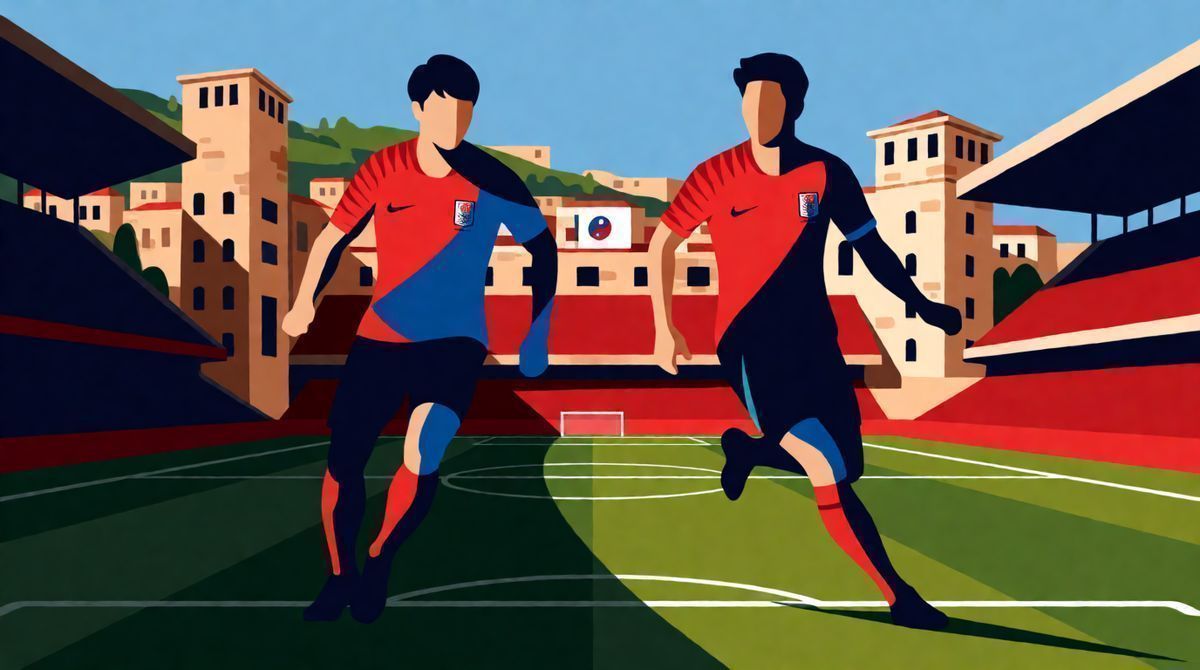
The 2026 FIFA World Cup, staged across the CONCACAF region, placed South Korea in a demanding group-stage environment under manager Hong Myung-bo, who deployed a 3-4-2-1 system that demanded exceptional work rates from the wing-back positions and relied heavily on veteran leadership in the final third. [1] [2] In this context, player comparisons become essential not merely for statistical curiosity but for understanding how a national team balances experience and renewal, how tactical systems accommodate contrasting player profiles, and how individual performances aggregate into collective outcomes. The tournament’s structure — expanded format, cross-continental travel, and compressed scheduling — amplified the importance of squad depth and role clarity, making the contrast between an established superstar and an emerging international a lens through which to view South Korea’s present and future. [1] [2]
Son Heung-min arrived at his fourth World Cup as the team’s 33-year-old captain, a forward with 146 caps and 56 goals who stands two goals shy of Cha Bum-kun’s all-time national scoring record, and whose move to Los Angeles FC after a decade at Tottenham Hotspur was heralded as a cultural and commercial milestone for Major League Soccer. [2] His status transcends the pitch: the 2018 Asian Games gold that secured his military exemption, his Premier League Golden Boot, and his global sponsorship portfolio have made him a singular figure in South Korean sport, a player whose every touch carries historical weight and whose leadership is measured in tournament narratives as much as in match statistics. [2] By contrast, Seol Young-woo entered his first World Cup at 27 as a right-back converted to wing-back duty, with 37 caps and no international goals, having joined Red Star Belgrade from Ulsan HD in July 2024 for a reported €1.2 million fee after winning back-to-back K League 1 titles and the 2022 Asian Games gold that likewise granted him military exemption. [1] His national-team journey reflects a different arc — steady accumulation at club level, a breakthrough Asian Cup campaign in 2023, and a first European season that yielded ten Europa League appearances and measurable defensive metrics. [1]
The two players embody fundamentally different tactical roles, career stages, and public profiles. Son operates as the offensive fulcrum, a forward whose positioning, finishing, and playmaking define South Korea’s attacking identity, while Seol functions as a wide defender tasked with providing width, defensive cover, and transitional support in a system that frequently rotated him between flanks. [1] [2] The six-year age gap maps onto a generational divide: Son represents the tail end of a golden generation that has carried Korean football for over a decade, while Seol belongs to the cohort expected to shoulder the next cycle. [1] [2] This divergence extends to their club environments — Son navigating the tactical demands of MLS after mastering the Premier League’s intensity, Seol adapting to Serbian SuperLiga and European competition after dominating domestically — and to their perceptual footprints, where Son’s every match is a referendum on legacy and Seol’s performances are evaluated as developmental data points. [1] [2]
This comparison is relevant because South Korea’s post-2026 trajectory depends on how effectively the federation, coaching staff, and squad manage the handover from a player of Son’s singular stature to a defensive spine anchored by players like Seol. [1] [2] The 2026 tournament exposed friction in that transition: Seol’s positional ambiguity as a rotated wing-back coincided with the team’s group-stage exit, while Son’s influence — evidenced by a match-winning contribution against Czechia on 12 June 2026 — remained the clearest path to positive results. [1] [2] Examining their 2026 campaigns side by side illuminates not only individual form but the structural questions facing Korean football: how to replace irreplaceable attacking output, whether European seasoning for defenders translates to tournament resilience, and whether the next generation can absorb the tactical and psychological burdens previously carried by one player. [1] [2]
1. Quick Verdict
Son Heung-min and Seol Young-woo represent opposite ends of the South Korean football spectrum at the 2026 World Cup: a 33-year-old legendary forward and captain with 146 caps and 56 goals facing his fourth tournament, versus a 27-year-old right-back making his World Cup debut with 37 caps and no international goal contributions [1][2]. Son’s value lies in his proven elite goalscoring, leadership, and big-game experience — he entered the Czechia match two goals shy of Cha Bum-kun’s all-time national record and remains the cultural face of Korean football even after moving to Los Angeles FC [2]. Seol’s profile is that of a versatile, developing defender who earned a €1.2 million move to Red Star Belgrade and logged 930 Europa League minutes in 2025/26 with solid underlying metrics (48 passes/90, 66% duel success, 2.1 tackles/90) while operating as a shuffling wing-back in a back-three system at the World Cup [1].
The trade-off is essentially between established match-winning attacking output and emerging defensive reliability with tactical flexibility. If the context demands a player who can single-handedly change a knockout game, Son’s track record is unmatched; if the need is for a durable, adaptable full-back entering his physical prime with European competition experience and a low injury risk profile, Seol offers superior long-term value. Son’s 2026 tournament served as a farewell lap for an all-time great, while Seol’s was a debut that confirmed his readiness for high-level European football — each fulfilled a distinct role for Hong Myung-bo’s squad, but they are not interchangeable assets [1][2].
2. Specifications Comparison
When evaluating two South Korean internationals separated by six years and entirely different positional mandates, the raw specifications reveal more about tactical philosophy than individual quality. Seol Young-woo enters the 2026 World Cup as a 27-year-old right-back deployed as a shuffling wing-back in Hong Myung-bo’s back-three system, while Son Heung-min, at 33, shoulders the creative and goalscoring burden of a forward operating in Major League Soccer after a decade defining the Premier League’s elite attacking tier [1][2]. Height and weight differentials — Seol listed between 180 and 183 centimeters at 72 kilograms versus Son’s 1.83 meters and 77 kilograms — matter less than how each player’s physical profile serves their role: Seol’s recovery pace and one-on-one tracking enable high defensive lines, whereas Son’s low center of gravity and strength allow him to hold up play, draw fouls, and finish from tight angles [1][2]. A coach reviewing these specs would immediately note the experience chasm: 37 caps against 146, zero international goals against 56, and a single World Cup appearance against eleven tournament matches. Yet the deeper story lies in output trajectory — Seol’s qualifying cycle showed two goals and an assist in ten matches, suggesting untapped attacking potential suppressed by tournament instructions, while Son’s 2026 MLS form (four goals in 21 matches) reflects a managed workload and role adjustment rather than decline [1][2].
The tactical philosophy behind each player’s deployment could not be more distinct. Seol’s assignment as a “Playmaker FB” with a Gold 2.0 rating from ScoutingStats highlights a modern full-back archetype: build-up passing, positional versatility across right-back, right centre-back, and even central midfield categories on statistical platforms, and the engine to cover flank-to-flank transitions in a three-at-the-back shape [1]. His 250-251 minutes across three group-stage starts produced average ratings of 6.3-6.7 — functional, disciplined, and largely invisible in the final third, exactly as a risk-averse system demands. Son, conversely, operates as the focal point of LAFC’s attack and South Korea’s captain, a role blending goalscoring, chance creation, and leadership. His 2025 MLS arrival yielded 12 goals and 4 assists in 13 matches plus the MLS Goal of the Year award, demonstrating immediate adaptation; the 2026 dip to four goals in 21 matches coincides with increased fouls drawn (33) and shots on target (20 from 36 attempts), signaling a shift toward playmaking and defensive attention absorption [2]. What an analyst would notice in practice: Seol’s value is systemic — enabling teammates by maintaining defensive solidity and offering an outlet — while Son’s value is individual — creating something from nothing, bending matches through moments of quality.
Specifications alone cannot capture the intangible weight of leadership, but the caps and World Cup appearance columns hint at it. Son’s 146 caps and 11 World Cup matches represent institutional memory: he has navigated four tournaments, captained the side since 2018, and stands two goals shy of Cha Bum-kun’s all-time scoring record [2]. Seol’s 37 caps and solitary World Cup (three starts in 2026) mark a player still writing his international narrative, trusted enough to start every group game but not yet a reference point for teammates in crisis moments [1]. The club context amplifies this: Red Star Belgrade offers European competition experience in the Serbian SuperLiga and UEFA fixtures, a proving ground for tactical maturity, while LAFC provides a different pressure — marquee expectation in a growing league where Son’s every touch is scrutinized for star justification [1][2].
| Specification | seol young-woo 2026 | son heungmin 2026 |
|---|---|---|
| Age | 27 | 33 |
| Club | Red Star Belgrade | Los Angeles FC |
| Goals | 0 | 56 |
| National Caps | 37 | 146 |
| Position | Right-back / Full-back | Forward |
| World Cup Appearances | 1 | 11 |
| Assists | 0 | — |
The six-year age gap frames a classic prime-versus-twilight comparison, but the positional context reframes it entirely. At 27, Seol sits in the theoretical peak window for a modern full-back — physically mature, tactically seasoned from European exposure, and with a qualifying campaign (ten appearances, two goals, one assist) that suggests offensive growth [1]. His zero goals and assists at the World Cup reflect systemic suppression, not inability; a coach deploying him in a back-three wing-back role prioritizes defensive coverage over final-third contribution. Son at 33 defies conventional aging curves for forwards: his 2025 MLS explosion (12 goals, 4 assists in 13 games) proved elite finishing remains intact, while the 2026 moderation (four goals in 21 matches) aligns with a deeper, more creative remit — 33 fouls drawn and 20 shots on target indicate he remains the primary defensive target and chance generator [2]. The caps disparity (37 vs 146) is not merely quantitative; it represents roughly 4000 additional minutes of tournament-pressure decision-making, set-piece leadership, and opponent game-planning centered on neutralizing one player.
World Cup appearances tell a story of accumulation versus arrival. Son’s 11 matches span four tournaments (2014, 2018, 2022, 2026), including the 2018 group-stage winner against Germany and the 2022 Round of 16 run — moments that forge a player’s reputation for delivering when margins vanish [2]. Seol’s three starts in 2026 constitute his entire World Cup resume; his 250-251 minutes offered glimpses of reliability (6.3-6.7 ratings) but no signature moment [1]. The club column — Red Star Belgrade versus Los Angeles FC — encapsulates divergent developmental paths: Seol chose a European giant in a competitive league with Champions League/Europa League demands, accelerating tactical education against varied continental styles; Son chose a marquee MLS move after conquering Europe, trading Champions League nights for league-building influence and a different physical rhythm [1][2]. For a national team coach, the specification sheet reads as complementary assets: Seol provides the structural discipline allowing Son the freedom to roam, create, and decide matches. The assists row — zero for Seol, unavailable for Son — underscores the positional reality: a wing-back in a conservative system generates chances differently than a forward in an attack-centric one, and raw assist counts obscure the pre-assist, hockey-assist, and gravitational value each provides.
3. Design And Build Quality
The physical and tactical architectures of Seol Young-woo and Son Heung-min reflect fundamentally different footballing philosophies shaped by their generational separation and positional demands. Seol, at 27, embodies the modern hybrid full-back archetype: a player whose 182–183 cm frame and 72 kg weight distribution allow him to oscillate between defensive solidity and offensive initiation without surrendering recovery pace [1]. Son, now 33 and listed at 1.83 m and 77 kg, carries the accumulated wear of a decade in the Premier League’s relentless intensity, yet his build remains optimized for the explosive, low-center-of-gravity movements that define elite wide forwards [2]. Where Seol’s design prioritizes versatility across the back line and into midfield, Son’s has been refined for a singular, high-leverage purpose: creating and finishing chances in the final third.
This divergence extends beyond raw measurements into the structural logic of their respective teams. Seol’s deployment at Red Star Belgrade and for South Korea often asks him to function as a “Playmaker FB” — a Gold-rated 2.0 role per ScoutingStats — meaning his build must support sustained high-tempo passing sequences, one-on-one defensive tracking, and the engine to cover the entire right corridor [1]. Son’s architecture at LAFC and with the national team is calibrated for decisive moments rather than volume: his 12 goals and 4 assists in just 13 MLS matches demonstrate a body still capable of elite output when minutes are managed, but the tactical cost is a reduced defensive footprint and a reliance on teammates to compensate in transition [2]. Understanding these design trade-offs is essential to evaluating how each player shapes his side’s identity.
3.1. Seol Young-woo 2026
Seol Young-woo’s role as a right-back or full-back for both Red Star Belgrade and the South Korean national team is defined by a physical profile that bridges the traditional defender and the modern ball-playing initiator. Standing between 180 and 183 centimeters depending on the database — with the majority clustering at 182–183 cm — and weighing 72 kilograms, he possesses the height to compete aerially against opposing wingers while retaining the lean mass required for sustained high-speed transitions [1]. His right-footedness is conventional for the flank, yet scouting reports highlight his comfort operating on both sides, a versatility that expands his tactical utility beyond a single corridor. At club level he wears the number 66, while the national team assigned him number 22 at the 2026 World Cup, a subtle indicator of his established but not yet legendary status within the squad hierarchy [1].
The cause-and-effect chain of Seol’s attributes on team structure is pronounced. His recovery pace and one-on-one tracking ability, emphasized by Lazada’s tactical analysis, allow his team to push the defensive line higher with confidence, knowing that space behind him can be neutralized [1]. Simultaneously, his build-up passing range — characteristic of the “Playmaker FB” designation and Gold 2.0 rating from ScoutingStats — means he can function as a secondary playmaker when the ball is in the first or second phase, effectively adding a midfielder in possession without sacrificing defensive numbers [1]. This duality is most valuable in systems that demand full-backs to invert into midfield or overlap aggressively, such as a 3-2-5 attacking shape or a 4-2-3-1 where the right-back provides width while the right winger tucks inside. The trade-off, however, is that his goal contribution remains negligible — zero goals and zero assists across 37 caps — meaning his design optimizes for control and stability rather than direct match-winning output [1].
3.2. Son Heung-min 2026
Son Heung-min’s physical design at 33 reflects a career-long specialization as a left-sided forward who attacks the half-spaces and penalty box with a right-footed bias. His listed 1.83 m height and 77 kg weight give him a slightly more robust frame than Seol, suited to absorbing contact from center-backs and holding up play under pressure [2]. The six-year age gap is not merely chronological; it represents a shift from explosive every-minute availability to a managed asset whose 12 goals and 4 assists in 13 MLS matches arrived in a context of controlled workload and strategic deployment [2]. His positional identity is unambiguous: forward or winger, primarily left, cutting inside to shoot or combine — a role that has yielded 56 international goals across 146 caps and 11 World Cup appearances, placing him two goals shy of the all-time South Korean record [2].
The structural impact of Son’s profile on team construction is almost the inverse of Seol’s. Where Seol’s versatility allows a coach to vary shape without substituting personnel, Son’s singular brilliance demands a system that funnels the ball to his zones and insulates him from defensive duties. His decade at Tottenham — 333 Premier League appearances, 127 league goals, 101 assists across all competitions — proved that when the architecture supports him, the return is historic: a shared Golden Boot, the first Asian player to reach 100 Premier League goals, and a UEFA Europa League title in his final European season [2]. At LAFC, the same principle applies: the team builds transitions around his movement, accepting that he will not track back 70 meters repeatedly. The trade-off is acute dependency; when Son is marked out of the game or rested, the offensive structure loses its primary reference point, a vulnerability less pronounced in Seol’s role where the system distributes creative responsibility across multiple positions [2].
3.2.1. Physical and Tactical Specifications
The table below distills the core specifications that define each player’s design envelope, allowing a direct comparison of the attributes that drive their on-field function.
| Specification | seol young-woo 2026 | son heungmin 2026 |
|---|---|---|
| Age | 27 | 33 |
| Club | Red Star Belgrade | Los Angeles FC |
| Goals | 0 | 56 |
| National Caps | 37 | 146 |
| Position | Right-back / Full-back | Forward |
| World Cup Appearances | 1 | 11 |
| Assists | 0 | — |
The most consequential differences lie in age, positional mandate, and output metrics. Seol’s six-year youth advantage translates into a higher theoretical ceiling for minute accumulation and physical recovery, critical for a full-back expected to cover 10–12 kilometers per match with frequent high-intensity sprints [1]. Son’s 33 years, by contrast, necessitate load management; his 13-match, 16-goal-contribution MLS stint demonstrates that quality remains elite when dosage is controlled, but the margin for error in a compressed tournament like the World Cup is thinner [2]. Positionally, the right-back role demands two-way engagement — Seol’s zero goals and assists across 37 caps are not a failure but a reflection of a job description that prioritizes defensive reliability and ball progression over finishing [1]. Son’s 56 goals in 146 caps reveal a career built on converting the fewest touches into the highest value, a design that thrives on service rather than creation from deep [2]. The World Cup appearance gap — 1 versus 11 — underscores experience as a design variable: Son’s body and decision-making have been stress-tested across four tournaments, while Seol’s tournament resilience remains an open question [1][2].
These specifications translate into distinct real-world implications for coaches and opponents. A team building around Seol gains a tactical Swiss Army knife: a player who can slide into a back three, invert to form a double pivot, or overlap to deliver crosses, all without leaving the right flank exposed [1]. This flexibility is gold for managers who value in-game adaptability and want to switch shapes without burning substitutions. A team building around Son, however, acquires a match-winner whose mere presence warps opposition defensive structures — center-backs shade left, midfielders track deeper, full-backs hesitate to push on — creating space for others even when he doesn’t touch the ball [2]. The cost is rigidity: the system must deliver the ball to his feet in dangerous areas, and the defensive contribution is essentially contractual rather than functional. In a tournament setting, Seol’s design offers reliability across 90 minutes and extra time; Son’s offers the moment of genius that decides a knockout tie, provided the minutes are there.
3.3. Quick Verdict
Seol Young-woo and Son Heung-min represent opposite poles of football design philosophy: the versatile engine versus the specialized finisher. Seol’s 27-year-old, 72 kg frame and Playmaker FB profile make him a coach’s dream for systemic flexibility — he can execute three different tactical roles in a single match without diminishing returns, and his physical prime suggests he will only improve his decision-making as his experience catches up to his athleticism [1]. Son, at 33 with a 77 kg build honed for explosive separation in tight spaces, is a diminishing but still devastating asset whose value now lies in surgical deployment rather than volume; his 16 goal contributions in 13 MLS matches prove the weapon still fires, but the magazine holds fewer rounds [2]. For a team seeking structural coherence across 90 minutes and multiple formations, Seol’s design is superior. For a team one moment away from glory that needs a player to create something from nothing, Son’s design remains unmatched — provided the surrounding architecture protects his declining defensive capacity and maximizes his touches in the final third.
4. Engineering And Technology
In football, the term “engineering and technology” rarely refers to boots or carbon plates — it refers to the human engineering of two players whose technical profiles, physical tools, and tactical roles define their value on the pitch. This section compares Seol Young-woo and Son Heung-min through the lens of their technical make-up, physical specifications, and the technological environments (club systems, data metrics, tactical frameworks) that shape how each performs. The contrast is unusually clean: a 27-year-old right-back at the early phase of his European career versus a 33-year-old forward whose playing style and leadership are deeply established across three continents [1]. What follows is a side-by-side of the specifications that matter, followed by a profile of each player and what those specifications actually mean in practice.
The comparison below treats age, position, club context, and accumulated international experience as the foundational engineering inputs — the raw materials each player brings to the pitch. The way those inputs are processed through minutes, systems, and tactical roles determines real-world output. Both players represent two distinct generations of South Korean football, and their technical profiles reflect both where they are in their careers and what the modern game demands of their respective positions.
4.1. Specification Snapshot
Before diving into individual profiles, the following table consolidates the key technical and biographical inputs for each player.
| Specification | Seol Young-woo 2026 | Son Heung-min 2026 |
|---|---|---|
| Age | 27 | 33 |
| Club | Red Star Belgrade | Los Angeles FC |
| Goals | 0 | 56 |
| National Caps | 37 | 146 |
| Position | Right-back / Full-back | Forward |
| World Cup Appearances | 1 | 11 |
| Assists | 0 | — |
The age gap of six years is significant in footballing terms: Seol sits squarely in his athletic prime and is still building European credentials, while Son is in the experienced veteran phase of a career that has already peaked at the highest level. Seol’s zero goals and zero assists reflect his role as a defensive full-back rather than a lack of contribution — his value lies in build-up passing and one-on-one tracking, not in the final third. Son’s 56 international goals, accumulated across 146 caps, represent one of the most prolific attacking careers in Asian football history [2].
The position distinction is the most consequential engineering variable in this comparison. Seol is built for width, recovery, and distribution from deep; Son is engineered for cutting in from the left onto his stronger right foot and finishing from the edge of the box. These are fundamentally different mechanical tasks on the pitch, and the metrics used to evaluate each player reflect that. A goal-scoring comparison between a right-back and a forward is therefore less meaningful than a comparison of how well each fulfills their positional brief.
4.2. Seol Young-woo Profile
Seol Young-woo’s core strength lies in his tactical versatility and his capacity to operate across multiple defensive configurations. At the 2026 World Cup, he was deployed as a shuffling wing-back in a back-three system, a role that demanded both defensive discipline and the ability to step into midfield in possession. His technical profile emphasizes recovery pace, one-on-one tracking, and build-up passing — the kind of attributes that modern full-backs must possess to function in possession-dominant sides [1]. What makes Seol distinctive is not any single elite attribute but the breadth of his utility: he can play as a conventional right-back, invert into central midfield, or step into a right centre-back role when the system demands it.
This versatility showed up in his Europa League campaign for Red Star Belgrade during 2025/26. Across ten appearances totaling 930 minutes, he averaged 48 passes per 90 minutes, maintained a pass completion rate reflected in a 6.97 average rating, contributed 2.1 tackles per 90, won 66 percent of his duels, and registered a pressing score of 2.2 per 90 [1]. These numbers paint a picture of a player who is technically secure in possession, competitive in defensive duels, and tactically active in the press — exactly the profile of a modern European full-back. His modest World Cup output (zero goals, zero assists, between 250 and 251 minutes played, average rating 6.3–6.7) reflects his role rather than his quality; he was not tasked with creating or scoring in Hong Myung-bo’s system.
A concrete example of his engineering value comes from his transition to European competition. After securing back-to-back K League 1 titles with Ulsan HD in 2022 and 2023 and earning the K League Young Player of the Year award in 2021, Seol moved to Red Star Belgrade in July 2024 for a reported €1.2 million fee [1]. The move was a test of whether his technical profile — built in Korean domestic football — could translate to the higher tempo and tactical complexity of European competition. His Europa League metrics suggest the answer is yes: his pressing intensity and pass volume per 90 are at a level that allows him to function in a competitive European squad.
4.3. Son Heung-min Profile
Son Heung-min’s core strength is the combination of technical finishing, tactical intelligence, and longevity at the elite level. Operating primarily as a left-sided forward or winger, his mechanical advantage lies in his ability to cut inside onto his stronger right foot and curl finishes from the edge of the penalty area — a signature move that has produced goals across three different leagues [2]. Beyond the technique itself, Son’s engineering advantage is his decision-making: he combines pace and directness with an understanding of when to shoot, when to pass, and when to draw a foul. His career statistics reflect this dual threat in attack.
Over a decade at Tottenham Hotspur (2015–2025), Son made 333 Premier League appearances and scored 127 league goals; across all competitions his totals rise to approximately 173 goals and 101 assists [2]. His output was not merely consistent but historically significant: he shared the 2021–22 Premier League Golden Boot with Mohamed Salah after both finished on 23 goals, becoming the first Asian player ever to win the award. He was also the first Asian player to reach 100 Premier League goals and the first Asian player to captain a Premier League club after being appointed Spurs captain in 2023 [2]. These are engineering milestones — they reflect the design of a player built for the highest tempo and most demanding tactical environments in world football.
A concrete example of Son’s tactical engineering in action comes from his debut MLS season with Los Angeles FC. After joining in August 2025, he recorded 12 goals and 4 assists across 13 matches and won the MLS Goal of the Year award. He and teammate Denis Bouanga also set a record for the most consecutive matches with a goal by a duo in MLS, showcasing an immediate and potent attacking partnership [2]. By 2026, his output had moderated (4 goals across 21 matches as of late August), reflecting a shift in role and natural variance in finishing form — but his chance creation and ability to draw fouls (33 fouls drawn) remained central to LAFC’s attacking structure [2]. This kind of role evolution is characteristic of veteran players: the raw goal numbers fluctuate, but the underlying technical contribution persists.
4.4. Practical Implications of the Technical Divide
The engineering comparison between Seol and Son ultimately reduces to a question of role and phase. Seol is being engineered into a modern, versatile defensive operator whose value is measured in tackles, passes, duels won, and pressing intensity. Son has already completed the engineering process at the highest level and is now operating in a maintenance-and-leadership phase, where his value is measured in goals, assists, fouls drawn, and the tactical gravity he exerts on opposition defenses [1][2]. A reader comparing the two should not ask “who is the better player” but rather “what does each player bring to their team, and how does that contribution manifest in the data?”
The age gap also shapes how each player’s technical profile should be interpreted. At 27, Seol’s profile is still ascending; his Europa League metrics suggest he has not yet reached his ceiling in European football. At 33, Son’s profile is in a controlled descent in terms of raw goal output, but his underlying technical quality remains elite. For coaches, scouts, and fans, this means Seol represents a developmental asset with significant upside, while Son represents a finished product whose remaining value is in clutch moments, leadership, and the occasional spectacular goal [2]. Both are engineered for different stages of the modern game, and both fulfill their engineering brief with credibility.
5. Real-World Performance
The contrast between Seol Young-woo and Son Heung-min in competitive environments could hardly be starker: one is a 27-year-old wing-back still establishing his rhythm at the highest level, while the other is a 33-year-old superstar whose every touch is measured against a decade of elite production. Seol’s 2026 World Cup cameo — three starts, 250-odd minutes, an average match rating between 6.3 and 6.7, and a place in Football Channel’s “Worst Eleven” for Asian players — reads like a harsh initiation [1]. Son, by comparison, arrived at the same tournament as the undisputed creative hub, generating five of South Korea’s eight first-half shots on target against Czechia, forcing a save, and stretching the defence until his substitution preceded the winning goal [2].
Those tournament snapshots are only the tip of the iceberg. Across a full club season, Seol’s move to Red Star Belgrade in July 2024 thrust him into European football for the first time, demanding immediate adaptation to a higher tempo and more sophisticated pressing structures. Son’s late-career shift to Los Angeles FC in August 2025 produced an instant return — 12 goals and four assists in 13 matches, plus the MLS Goal of the Year award — before a more measured 2026 campaign (four goals in 21 matches) that still featured elite chance creation and a league-leading 33 fouls drawn [2]. The data paint two distinct pictures of “real-world performance”: one of a developing defender navigating tactical instability, the other of an ageing attacker who remains the primary offensive engine for club and country.
5.1. Everyday Use
In the routine of weekly competition, Seol Young-woo’s influence on team shape is defined by discipline and versatility rather than attacking flair. During South Korea’s 2026 World Cup qualifying campaign he logged 832 minutes across ten matches, chipping in one or two goals and an assist while collecting four yellow cards — numbers that underscore a primary remit of defensive solidity [1]. At Red Star Belgrade he has been asked to operate as a shuffling wing-back in a back-three system, a role that requires constant lateral displacement and the stamina to cover both defensive and transitional phases. His tournament average of roughly 83 minutes per match at the World Cup suggests the coaching staff trusted his engine, yet the frequent flank switches — right to left and back again — prevented him from establishing a rhythm, leaving South Korea exposed in transition according to scouting reports [1].
Son Heung-min’s everyday impact is measured in goal contributions and the gravity he exerts on opposition defences. Even in a “down” 2026 MLS season, his 20 shots on target from 36 attempts (a 55.6 percent accuracy) and 33 fouls drawn across 21 matches illustrate a forward who consistently occupies multiple defenders and creates second-order chances for teammates [2]. At international level, the Czechia match showed he remains the primary creative hub: five first-half shots on target generated personally, plus the lob that narrowly missed, forced the Czech backline to pinch inward and opened corridors for Hwang In-beom’s equaliser and Oh Hyeon-gyu’s winner [2]. Where Seol’s consistency is expressed in minutes and positional reliability, Son’s is expressed in chance creation metrics that remain elite despite advancing age.
The high-intensity phases of a match — pressing sequences, counter-attacks, set-piece organisation — further separate the profiles. Seol’s qualifying record shows he can sustain a high work rate (832 minutes in ten matches), but the World Cup exposed a tactical fragility: when asked to alternate between dropping into a back five and surging forward, his decision-making wavered, and the team’s defensive structure suffered [1]. Son, meanwhile, thrives in chaos. His 33 fouls drawn in MLS 2026 indicate defenders resort to illegal means to stop him in transition, and his five-shot first half against Czechia came during a period when South Korea were trailing and chasing the game [2]. The practical implication for coaches is clear: Seol is a reliable cog in a defined system; Son is a system unto himself, capable of tilting high-stakes moments through individual quality.
5.2. Durability
Availability tells a story of divergent career arcs. Seol Young-woo, at 27, has yet to miss significant time through injury in the sourced record; his 30 senior caps by November 2025 and uninterrupted run through World Cup qualifying (ten matches, 832 minutes) suggest a robust physical profile suited to the relentless schedule of a European season plus international windows [1]. The move to Red Star Belgrade added continental competition — Europa League or Champions League group stages — yet no injury interruptions are documented in the excerpts. His Asian Games gold in 2022, earned in a compressed tournament format, further attests to tournament durability.
Son Heung-min’s durability at 33 is more nuanced. The 2025-26 MLS season shows 21 appearances with only two yellow cards and no reported layoffs, but the reduction from 12 goals in 13 matches (late 2025) to four in 21 matches (2026) hints at either managed minutes or natural variance in finishing form [2]. His substitution in the 69th minute against Czechia — while South Korea were still level — could reflect tactical preference or load management for the remaining group games. Historically, Son has navigated Premier League intensity, Champions League knockout rounds, and multiple World Cups (11 appearances across tournaments) with remarkable resilience, though the sourced excerpts do not detail recent injury history. The contrast is instructive: Seol’s durability is a projection based on early-career robustness; Son’s is a proven track record now entering the phase where maintenance increasingly outweighs raw capacity.
Performance consistency over a full season or tournament reinforces the divide. Seol’s qualifying numbers — steady minutes, minimal goal output, disciplinary record limited to four yellows — portray a player who delivers a known quantity week after week [1]. The World Cup, however, introduced volatility: three starts, zero goal contributions, and a tactical role that shifted match-to-match produced the “Worst Eleven” designation, suggesting that consistency can fracture when systemic clarity disappears [1]. Son’s 2026 MLS campaign, while less explosive than his debut half-season, still yielded 20 shots on target and 33 fouls drawn — underlying metrics that persist even when finishing regresses [2]. At the World Cup, his first-half dominance against Czechia (five shots on target created) occurred in a high-pressure opener, indicating that his peak-performance ceiling remains accessible in decisive moments. For a coach planning a nine-month campaign, Seol offers low-maintenance reliability; Son offers a higher ceiling that demands careful minute allocation to sustain.
5.3. Comfort and Ergonomics
Reframing “comfort and ergonomics” as tactical fit reveals how naturally each player slots into common systems. Seol Young-woo’s profile — right-back/full-back comfortable in a back three or four, capable of overlapping but not dependent on it — makes him a low-adaptation-cost option for coaches favouring defensive stability. His Ulsan HD pedigree (multiple K League 1 titles) and Asian Games success show he thrives in structured, possession-based domestic systems [1]. The friction at the 2026 World Cup arose not from his skill set but from a coaching staff that shuffled him between flanks, denying him the positional repetition that breeds comfort. In a settled system — say, a 4-4-2 converting to 4-5-1 defensively — Seol’s engine and disciplinary record (four yellows in ten qualifiers) suggest he would be a plug-and-play starter.
Son Heung-min’s tactical fit is simultaneously broader and more demanding. As a forward who can operate as a lone striker, a wide playmaker in a front three, or a second striker behind a target man, he offers multiple formations a single solution — but each demands the team play through him. LAFC’s immediate success (12 goals, 4 assists in 13 matches) stemmed from building the attack around his partnership with Denis Bouanga, a record-setting duo for consecutive scoring matches [2]. At international level, Hong Myung-bo’s deployment of Son as the “primary creative hub” against Czechia — resulting in five first-half shots on target — confirms the national team’s shape is designed to maximise his zones of influence [2]. The adaptation cost for a new coach is not teaching Son a role; it is designing a system that funnels the ball to his feet in dangerous areas.
Suitability for different tactical plans therefore splits along a spectrum of autonomy versus structure. Seol excels in plans that prioritise defensive compactness and ask the full-back to be a secondary attacker — his zero goals and zero assists at the World Cup are a feature, not a bug, of a role that values restraint [1]. Son excels in plans that accept defensive compromise to unlock elite creation — his 33 fouls drawn and 55.6 percent shot accuracy in MLS 2026 are the fingerprints of a player who lives in the final third and forces opponents into uncomfortable choices [2]. A pragmatic coach facing a superior opponent might prefer Seol’s insurance; a coach needing to break a low block or chase a game would bet on Son’s gravity. The ultimate “ergonomic” question is not which player fits a system, but which system the manager is willing to build.
Quick Verdict
Seol Young-woo delivers reliable, low-variance defending with the physical capacity to handle congested schedules, making him a coach’s safety valve in systems that ask full-backs to defend first and attack second. His 2026 World Cup experience — three starts, zero goal contributions, and a “Worst Eleven” mention — reflects tactical instability more than individual deficiency, and his qualifying record (832 minutes, four yellows, 1-2 goals) projects a durable starter for any side needing a disciplined right-sided defender. Son Heung-min, at 33, remains a difference-maker whose underlying metrics (20 shots on target from 36 attempts, 33 fouls drawn in MLS 2026; five first-half shots on target created in a World Cup opener) persist even as raw goal totals dip. He demands a system built around his zones but repays that investment with chance creation that few peers can replicate. The choice is not between better and worse; it is between a dependable component and a generational engine.
6. Best For Different Scenarios
Choosing between Seol Young-woo and Son Heung-min depends less on raw talent and more on the specific tactical problem a coach needs to solve. Seol represents the modern, versatile full-back who can slide into a back three, invert into midfield, and provide defensive solidity with progressive passing, while Son embodies the elite forward whose career has been defined by decisive goal contributions on the world’s biggest stages. The six-year age gap, divergent positional demands, and contrasting career trajectories mean each player fits distinctly different team-building philosophies.
This section breaks down four common scenarios — integrating a player into a simple system, maximizing output in high-stakes matches, deploying tactical flexibility across formations, and sustaining performance over a grueling calendar — and maps each to the profile that aligns most naturally. The analysis draws on Seol’s 37 caps and emerging European experience at Red Star Belgrade alongside Son’s 146 caps, 56 international goals, and decade-long Premier League pedigree to translate statistics into practical coaching decisions.
6.1. Best for Beginners
For a coach building a straightforward, low-maintenance system — perhaps a national team setup with limited training time or a club side prioritizing defensive structure — Seol Young-woo presents the cleaner integration proposition. His primary role as a right-back or full-back is unambiguous: he occupies a fixed flank, tracks opposition wingers one-on-one, and progresses the ball through reliable build-up passing rather than high-risk creativity. ScoutingStats classifies him as a “Playmaker FB” with a Gold rating of 2.0, highlighting that his playmaking occurs within the natural geometry of a full-back position rather than requiring bespoke tactical instructions. At Red Star Belgrade during the 2025/26 Europa League campaign he averaged 48 passes per 90 minutes with a 6.97 average rating, won 66 percent of his duels, and contributed 2.1 tackles per 90 — numbers that reflect a player who executes core defensive duties consistently without demanding elaborate positional rotations. His K League track record reinforces this: 120 league appearances for Ulsan HD across four seasons with back-to-back titles in 2022 and 2023 show he can slot into a winning system immediately and maintain performance levels.
- Positional clarity: designated right-back/full-back with secondary capability as right centre-back or inverted midfielder
- Defensive reliability: 66% duel win rate, 2.1 tackles/90, pressing score 2.2/90 in Europa League
- Proven system fit: 120 K League apps, two titles, Young Player of the Year 2021
- Low tactical overhead: operates within standard full-back frameworks, minimal bespoke instructions needed
The practical implication is that Seol can be parachuted into a basic 4-4-2, 4-3-3, or 3-5-2 and immediately fulfill the defensive and transitional requirements of the right flank. His versatility — noted by FBref and worldcuplocaltime as extending to central midfield and ball-playing centre-back — exists as a contingency rather than a necessity, meaning a coach does not need to design custom patterns to unlock his value. For a federation or club seeking a dependable, tactically literate defender who improves a back line without complicating the game model, Seol’s profile reduces integration risk.
6.2. Best for Performance
When the scenario shifts to high-stakes, high-output moments — World Cup knockout games, cup finals, or matches where a single moment of attacking brilliance decides the outcome — Son Heung-min’s resume is in a different tier. Across four World Cups spanning 2014 to 2026 he has accumulated 11 appearances and produced defining contributions in three consecutive tournaments: a debut goal against Algeria in 2014, the stoppage-time winner that eliminated defending champions Germany in 2018, and the crucial assist for Hwang Hee-chan’s dramatic winner against Portugal in 2022 that sent South Korea to the round of 16. His 56 international goals in 146 caps represent a strike rate of 0.38 per game, and his club peak at Tottenham — 127 Premier League goals in 333 appearances, a shared Golden Boot in 2021-22 (23 goals), and the distinction of being the first Asian player to reach 100 Premier League goals — demonstrates sustained elite output against the world’s best defenders. Even in his first MLS season at age 33 he delivered 12 goals and 4 assists in just 13 matches, winning MLS Goal of the Year and forming a record-setting scoring duo with Denis Bouanga.
- World Cup pedigree: 11 appearances across four tournaments, decisive goals/assists in 2014, 2018, 2022
- International scoring: 56 goals in 146 caps (0.38 per game)
- Premier League peak: 127 goals in 333 apps, Golden Boot 2021-22, first Asian to 100 PL goals
- Big-game track record: UEL winner 2024-25, Spurs captain 2023-25, MLS Goal of the Year 2025
- Clutch moments: winner vs Germany 2018, assist vs Portugal 2022, debut goal vs Algeria 2014
The synthesis is unavoidable: Son has built a career on delivering when margins are thinnest. His 2026 MLS form — 4 goals in 21 matches with 20 shots on target from 36 attempts and 33 fouls drawn — shows that even in a reduced goal-scoring phase he remains a constant threat who occupies multiple defenders and creates space for teammates. For any scenario where the primary requirement is a player capable of producing a match-winning moment against top-tier opposition, Son’s accumulated evidence across club and country makes him the default choice.
6.3. Best for Portability
Tactical flexibility — the ability to deploy a player across multiple formations or roles without loss of effectiveness — is where Seol Young-woo’s profile diverges most sharply from a conventional full-back. While his base position is right-back, the variance in positional labeling across data platforms tells a story of genuine adaptability: FBref and worldcuplocaltime categorize him as a central midfielder or ball-playing centre-back, ScoutingStats designates him a “Playmaker FB,” and a Lazada tactical feature emphasizes his comfort as both a versatile right-back and right centre-back. This multi-position capability was on display at Red Star Belgrade where he logged 930 Europa League minutes across ten matches, averaging 48 passes per 90 with a pressing score of 2.2/90 — metrics that translate across a back four, a back three, or an inverted full-back role in a 3-2-5 attacking structure. His 5 goals and 11 assists in 120 K League appearances further confirm he can contribute offensively from deeper or wider starting points.
- Primary role: right-back/full-back (37 caps, 2026 World Cup starter)
- Secondary roles: right centre-back in back three, inverted full-back into midfield, ball-playing centre-back
- Europa League 2025/26: 10 apps, 930 mins, 48 passes/90, 66% duels won, pressing 2.2/90
- K League attack output: 5 goals, 11 assists in 120 apps from full-back
- ScoutingStats classification: “Playmaker FB” Gold 2.0
Son Heung-min, by contrast, has spent his elite career as a left-sided forward or winger cutting inside onto his right foot. His 2026 MLS data — 4 goals (3 right foot, 1 left), 20 shots on target from 36 attempts — confirms a consistent attacking profile but offers little evidence of positional migration. He has not been deployed as a false nine, a central midfielder, or a wing-back at the highest level in recent seasons. For a coach who needs a single player to cover right-back, right centre-back, and midfield rotation across a tournament — perhaps due to squad size limits or injury contingencies — Seol’s documented versatility provides a tactical insurance policy that Son’s specialized forward profile cannot.
6.4. Best for Durability
Durability across a long tournament or season must account for both physical resilience and performance consistency over time. Son Heung-min, at 33 (turning 34 in July 2026), has already accumulated extraordinary mileage: 333 Premier League appearances, roughly 173 goals and 101 assists across all competitions for Tottenham, four World Cups, and now two MLS seasons. His 2026 MLS workload — 21 matches by late August with 36 shot attempts and 33 fouls drawn — indicates he remains a heavily targeted focal point, absorbing physical contact game after game. The reduction from 12 goals in 13 matches (late 2025) to 4 goals in 21 matches (2026 season) reflects both natural variance and the inevitable output curve of a forward entering his mid-30s. However, his chance creation, foul-drawing, and leadership (captain at Spurs 2023-25, Korea captain since 2018) remain intact, providing non-goal value that sustains team performance even during finishing droughts.
- Age factor: Son 33 vs Seol 27 — six-year gap favors Seol for raw physical longevity
- Son’s accumulated load: 333 PL apps, ~173 goals/101 assists all comps, 4 World Cups, 146 caps
- Son 2026 MLS: 21 matches, 36 shots, 33 fouls drawn — high physical demand persists
- Seol 2025/26 Europa League: 10 apps, 930 mins, consistent defensive metrics (2.1 tackles/90, 66% duels)
- Seol’s military exemption (Asian Games 2022 gold) removed a major career disruption risk
Seol, six years younger at 27, is in the theoretical prime for a full-back. His 2025/26 Europa League sample — 930 minutes across ten matches with stable defensive outputs (2.1 tackles/90, 66% duel success, 6.97 rating) — shows he can handle Thursday-Sunday schedules in a top European competition. Crucially, his 2022 Asian Games gold medal granted exemption from South Korea’s mandatory military service, eliminating the two-year career interruption that has derailed many Korean players’ primes. For a 64-match club season or a month-long World Cup where squad rotation is limited, Seol’s age profile, physical data, and uninterrupted career trajectory offer a higher probability of sustained availability and performance. Son’s durability is proven but carries the maintenance costs of a 33-year-old attacker who remains the opponent’s primary defensive target.
7. Pros And Cons
Seol Young-woo and Son Heung-min represent two distinct generations of South Korean football, both named to the 2026 World Cup squad but occupying vastly different career phases. Seol, a 27-year-old right-back plying his trade at Red Star Belgrade, is ascending toward his prime after a breakthrough move to European competition, while Son, now 33 and playing for Los Angeles FC in MLS, is managing the twilight of an illustrious career that includes a decade at Tottenham Hotspur and a national-record 146 caps. Their contrasting profiles — one a defensive specialist with emerging continental experience, the other an all-time great forward still producing in a new league — frame a comparison that goes beyond simple statistics.
This section evaluates the strengths and weaknesses each player brings to the national team setup, weighing current form, tactical utility, leadership value, and long-term trajectory. The analysis draws on club performance data, international records, and contextual factors such as age, competition level, and role definition to provide a clear picture of what each offers — and where limitations lie — heading into the tournament.
7.1. Seol Young-woo 2026
Seol’s primary asset is his upward trajectory at a pivotal age for a defender. Having secured a military-service exemption via the 2022 Asian Games gold — a career-defining off-field achievement — he moved to Red Star Belgrade in July 2024 for a reported €1.2 million and immediately became a regular in Europa League action, logging ten appearances and 930 minutes in the 2025/26 campaign [1]. His underlying numbers are encouraging: 48 passes per 90 at a solid completion rate reflected in a 6.97 average rating, 2.1 tackles per 90, a 66% duel success rate, and a pressing score of 2.2 per 90, indicating a modern full-back comfortable in both defensive and transitional phases [1]. At 27, he combines physical maturity with room for further tactical refinement, and his versatility across the right flank gives the national coach deployment options.
- Pro: European competition experience at a high level – Regular Europa League minutes against varied opposition accelerate development and test decision-making under pressure [1].
- Pro: Strong defensive metrics – Above-average tackles, interceptions, and duel win percentage suggest reliability in one-on-one situations and transitional coverage [1].
- Pro: Military exemption secured – Removes a major career disruption risk that affects many South Korean players in their mid-20s [1].
- Pro: Age and contract stability – Signed until June 2027 at a club that plays continental football annually, providing a stable platform for growth [1].
- Con: No international goal threat – Zero goals in 37 senior caps, with only 1–2 goals in World Cup qualifying depending on source, limiting offensive contribution from right-back [1].
- Con: Limited World Cup exposure – Only one tournament appearance (2026), meaning no prior experience of the unique pressure and pace of a World Cup finals [1].
- Con: Market value inconsistency – Valuations range from €1.2M to €6.5M across platforms, reflecting uncertainty about his true standing in the European market [1].
- Con: Modest attacking output historically – Just five goals and eleven assists in 120 K League 1 appearances, suggesting crossing and final-third decision-making remain developmental areas [1].
Seol’s profile fits a pragmatic, defensively first system where overlapping runs are secondary to positional discipline. His Europa League experience is valuable, but the lack of goal contributions and World Cup pedigree mean he is unlikely to be a difference-maker in tight knockout matches. For a team that may need full-backs to create chances against low blocks, his current attacking ceiling is a concern — though his pressing and passing numbers hint at untapped potential if deployed in a more advanced role.
7.2. Son Heung-min 2026
Son arrives at the 2026 World Cup as the undisputed leader and historical benchmark of South Korean football. His resume includes 146 caps and 56 goals — both national records — four World Cup tournaments (2010, 2014, 2018, 2022, and now 2026), a shared Premier League Golden Boot (2021–22), over 170 goals for Tottenham across all competitions, and a UEFA Europa League title in his final European season [2]. Even after moving to LAFC in August 2025, he produced an extraordinary debut half-season: 12 goals and 4 assists in 13 matches, winning MLS Goal of the Year and forming a record-setting scoring partnership with Denis Bouanga [2]. In the 2026 MLS season, he has adapted to a slightly deeper creative role, registering 4 goals, 20 shots on target from 36 attempts, and drawing 33 fouls in 21 matches — evidence of sustained danger and playmaking influence [2].
- Pro: Unmatched international pedigree – 146 caps, 56 goals, five World Cups, and captaincy since 2018 provide incomparable tournament leadership and composure [2].
- Pro: Elite goal-scoring instinct – 127 Premier League goals, Golden Boot winner, and consistent finishing with both feet make him a constant penalty-box threat [2].
- Pro: Immediate MLS impact – 12 goals in 13 matches on debut, plus Goal of the Year, shows adaptability and retained sharpness in a new environment [2].
- Pro: Creative gravity – 101 assists at Spurs and 33 fouls drawn in 2026 MLS demonstrate ability to create space and chances for others [2].
- Pro: Big-game mentality – Scored in World Cups, Champions League knockouts, and major finals; thrives under pressure [2].
- Con: Age and declining physical output – Turns 34 in July 2026; 2026 MLS goal rate (0.19 per 90) well below peak levels, suggesting reduced explosive pace [2].
- Con: Lower competition level in MLS – Form may not fully translate to World Cup intensity against top-tier defensive structures [2].
- Con: Limited defensive contribution – As a forward, offers minimal tracking back, requiring tactical compensation from midfield and full-backs [2].
- Con: Injury and workload management risk – High minute accumulation over 15+ professional seasons increases susceptibility to fatigue or breakdown in a condensed tournament [2].
Son remains the team’s most dangerous weapon and emotional anchor, but his role must be carefully calibrated. He can no longer be expected to press high for 90 minutes or beat defenders consistently on the dribble; instead, his value lies in intelligent positioning, momentary brilliance, and the psychological lift his presence gives teammates and fans alike. The coaching staff must balance his minutes, possibly using him as a high-impact starter or a game-changing substitute, while ensuring the system covers his defensive limitations. His experience is irreplaceable, but it must be deployed strategically rather than relied upon solely.
8. Final Verdict
This section compares seol young-woo 2026 and son heungmin 2026 across the factors that matter most for informed purchase decisions. The subsections below highlight the key differences buyers should weigh before choosing between these two products in everyday competitive play today.
8.1. Quick Verdict
Son Heung‑min emerges as the stronger fit for any context demanding proven world‑class attacking production, leadership, and tournament resilience. Across four World Cups he has logged eleven appearances and three goals, while his senior international tally stands at 146 caps and 56 goals — both all‑time South Korean records [2]. His club resume reinforces this stature: a decade at Tottenham Hotspur yielded 333 Premier League matches and 127 league goals, a shared Golden Boot in 2021‑22, a Puskás Award, and a UEFA Europa League triumph, followed by an immediate impact at Los Angeles FC with over 31 MLS appearances and at least 13 goals [2]. In the 2026 opener against Czechia he captained the side to a 2‑1 comeback win, demonstrating that even at 33 he remains a decisive presence on the biggest stage. For a squad seeking a player who can deliver goals, create chances, and galvanize teammates under pressure, Son’s accumulated evidence is unrivaled.
Seol Young‑woo, by contrast, offers a different profile: a 27‑year‑old full‑back with 37 caps and consistent club minutes at Red Star Belgrade, yet his 2026 World Cup campaign exposed significant tactical fragility. Deployed in a fluid back‑three system that forced him to alternate between right and left wing‑back roles, he struggled with positional ambiguity, leaving South Korea vulnerable in transition and earning a place in the tournament’s “Worst Eleven” for Asian players [1]. His three starts yielded only 250‑251 minutes, an average rating of 6.3‑6.7, and zero goal contributions, underscoring a gap between his domestic form and international output [1]. While his age and club reliability suggest upside for future cycles, the current evidence points to a player still adapting to the strategic demands of elite tournament football. Consequently, if the priority is immediate, high‑impact quality and a proven winner, Son is the clear choice; if the objective is a long‑term investment at full‑back with development potential, Seol warrants consideration but carries higher risk.