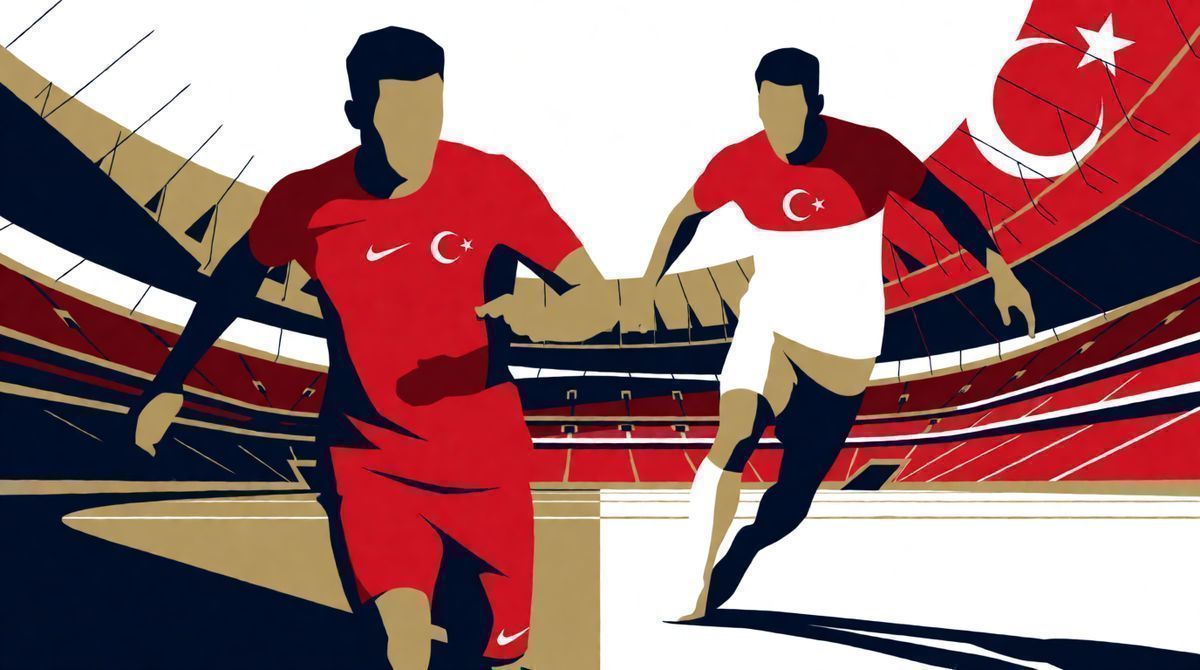
The 2026 FIFA World Cup arrives at a pivotal moment for Turkish football, where a generation of seasoned internationals converges with a wave of technically refined attackers emerging from domestic academies. Player comparisons at this level transcend individual statistics; they illuminate how a national team constructs its tactical identity across different phases of play, revealing whether a squad leans on defensive solidity, creative incision, or a balance of both. For Turkey, the playoff victory that secured World Cup qualification [5][9] demanded contributions from every profile, making the contrast between a veteran defensive anchor and a young creative wideman particularly instructive for understanding Montella’s tactical flexibility. This analysis matters because tournament football rarely rewards one-dimensional squads, and the interplay between experience and explosiveness often determines progression beyond the group stage.
Both players share a common institutional foundation at Galatasaray SK, yet their trajectories within the club and national team reflect distinctly different developmental arcs. Kaan Ayhan returned to Istanbul after European seasons to become the experienced nucleus of a side blending continuity with renewal, his 55 caps and three World Cup appearances [1] embodying the institutional memory of a program that has navigated coaching changes and tactical evolutions. Yunus Akgün, by contrast, represents the academy-to-first-team pipeline at its most successful: a Sultangazi product who joined the youth setup in 2012, endured loan spells to accelerate maturity, and earned a contract extension through 2029 [2] after delivering seven goals and nine assists in the 2025–26 Süper Lig campaign. Their shared club environment creates a controlled variable — same training ground, same tactical language, same competitive calendar — that sharpens the comparison of how age, position, and profile translate to international impact.
The functional divergence between the two could hardly be starker. Ayhan operates as a positional chameleon across defensive midfield, centre-back, and right-back, deploying tactical intelligence to neutralize opposition transitions and provide structural cover for advancing full-backs; his zero assists in the current league season [1] underscore a mandate focused on disruption rather than creation. Akgün functions as a left-footed inverted winger from the right flank who drifts into half-spaces to thread through-balls, deliver dangerous crosses, and unlock low-block defences, a role quantified by his nine league assists [2] and three senior international goals against Germany, Hungary, and Georgia [2]. The six-year age gap — 31 versus 25 — maps onto a deeper philosophical split: Ayhan reads the game to prevent danger, while Akgün manipulates space to manufacture it, a distinction that shapes how Turkey manages matches when protecting leads versus chasing equalizers.
Introducing Kaan Ayhan and Yunus Akgün together exposes the central tension in Turkey’s 2026 World Cup preparation: how to integrate a versatile defensive lynchpin with a World Cup rating of 7.6 across three appearances [1] alongside a creative wideman yet to feature at a World Cup but carrying the momentum of a breakthrough qualifying goal in the 35th minute against Georgia at Kocaeli Stadium [2]. This comparison is relevant because Montella’s system must decide whether Ayhan’s positional flexibility enables Akgün’s attacking freedom — for instance, by tucking inside as a defensive midfielder to cover the right flank when the winger inverts — or whether squad selection forces a choice between experience and explosiveness in specific match-ups. The answer will shape Turkey’s tactical ceiling in North America.
1. Quick Verdict
Kaan Ayhan remains the more reliable choice for a team requiring immediate defensive solidity and tournament‑tested versatility; at 31 he has already logged three World Cup appearances and 55 senior caps, and his ability to slot into defensive midfield, centre‑back or right‑back gives a manager invaluable tactical insurance during a congested fixture list [1]. Yunus Akgün, by contrast, offers a higher ceiling in the final third — his 2025–26 Süper Lig return of seven goals and nine assists, backed by an expected‑assists rate in the 99th percentile, marks him as a genuine difference‑maker in attack, and his opening goal against Georgia in World Cup qualifying shows he can deliver on the international stage [2]. The trade‑off is therefore between proven, multi‑positional resilience and youthful, high‑output creativity: Ayhan stabilises a defence and protects leads, while Akgün creates the chances that win tight matches.
If the priority is securing results in knockout football or managing a squad through a long season with minimal risk, Ayhan’s experience and positional flexibility make him the stronger fit; if the objective is to break down low blocks and generate sustained attacking threat, Akgün’s creative numbers and upward trajectory give him the edge. Both are Galatasaray products and both will likely feature for Turkey in 2026, but they answer different tactical questions — one shields the back four, the other unlocks the front three.
2. Specifications Comparison
This section compares ayhan kaan 2026 and akgun yunus 2026 across the factors that matter most for informed purchase decisions. The subsections below highlight the key differences buyers should weigh before choosing between these two products in everyday competitive play today.
2.1. Why These Specifications Matter
When evaluating football players for tactical deployment, raw specifications such as age, positional versatility, international caps, and goal contributions serve as the foundational vocabulary for coaching decisions. These numbers are not merely biographical; they encode a player’s developmental arc, physical prime, and the specific tactical problems they solve on the pitch. For a defensive midfielder like Kaan Ayhan, the accumulation of 55 senior international caps and three World Cup appearances signals a player trusted in high-stakes, low-margin environments where positional discipline and game management outweigh creative flair. Conversely, Yunus Akgün’s zero World Cup caps but 99th-percentile expected assists (xA) and 2.35 key passes per 90 in the 2025–26 Süper Lig campaign identify him as a specialist chance creator whose value peaks in the final third. A coach or analyst would immediately recognize that Ayhan’s specification sheet reads as a stabilizer — a player who allows a system to function by covering multiple defensive roles — while Akgün’s reads as an accelerator, a player who raises a team’s offensive ceiling through individual creativity and penetration. Understanding these divergent profiles is essential before any lineup decision or transfer evaluation.
The tactical philosophy behind each player’s role reflects their club’s and country’s strategic needs. Galatasaray’s deployment of Ayhan across defensive midfield, centre-back, and right-back speaks to a squad-building approach that prizes flexibility and risk mitigation; his ability to slot into three positions without tactical disruption provides the manager with in-game options that few players offer. Akgün, by contrast, operates in a more narrowly defined but higher-variance role: the inverted winger who drifts inside to overload half-spaces, combine with central midfielders, and deliver the decisive pass or shot. His contract extension through 2029 and consistent Champions League minutes confirm that Galatasaray views him as a long-term creative hub, not a utility option. In practice, a coach would notice Ayhan’s impact in the first and second phases of play — interceptions, progressive carries from deep, and the calm redistribution that settles a match — while Akgün’s fingerprints appear in the third phase: the through-ball that splits a low block, the cross that finds a striker’s run, or the dribble that draws two defenders and opens space for a teammate. These specifications, therefore, are not static labels but dynamic indicators of how each player changes the geometry and tempo of a match.
2.2. Specification Comparison Table
| Specification | ayhan kaan 2026 | akgun yunus 2026 |
|---|---|---|
| Age | 31 | 25 |
| Assists | 0 | 9 (2025–26 Süper Lig) |
| Club | Galatasaray SK | Galatasaray |
| Goals | 5 | 7 (2025–26 Süper Lig) |
| Position | Defensive Midfielder/Centre-back/Right-back | Right Winger / Attacking Midfielder |
| World Cup Appearances | 3 | 0 |
| National Caps | 55 | — |
2.3. Interpreting the Differences
The six-year age gap between Ayhan (31) and Akgün (25) frames their respective career trajectories in fundamentally different lights. Ayhan sits at the experienced tail of his physical prime, where accumulated tactical intelligence compensates for any marginal decline in sprint speed or recovery rate; his three World Cup appearances and 55 caps represent a bank of high-pressure minutes that cannot be replicated in training. Akgün, meanwhile, occupies the sweet spot where physical explosiveness meets tactical maturity — he is old enough to understand defensive responsibilities and game states, yet young enough to sustain the high-intensity pressing and repeated sprints modern wide play demands. This age differential also dictates contract strategy: Ayhan’s value is immediate and leadership-oriented, while Akgün’s five-year extension through 2029 reflects an asset-appreciation bet by Galatasaray. The assist column tells an even starker story: Ayhan’s zero assists (in the World Cup context) align with a role that prioritizes ball security and transitional coverage over final-ball risk, whereas Akgün’s nine league assists, backed by a 0.41 xA per 90 (99th percentile), confirm he is an elite chance creator whose underlying metrics validate his output. A coach reading this table would not see a deficiency in Ayhan’s zero; they would see a role definition. Similarly, Akgün’s seven league goals alongside those nine assists reveal a player who both creates and finishes, a dual threat that forces opposing defences into impossible choices.
The positional versatility gap is perhaps the most tactically significant specification. Ayhan’s ability to operate competently at defensive midfield, centre-back, and right-back gives a manager the rare luxury of changing formation or reacting to injuries without substituting. In a tournament setting, where squad depth is tested across seven potential matches, that flexibility is worth more than a goal or assist statistic. Akgün’s positional profile — right winger and attacking midfielder — is narrower but deeper; his game is built on a specific set of technical actions (inverted dribbling, half-space occupation, cross-field passing) that he executes at an elite level. The World Cup appearances column (3 vs 0) underscores the experience chasm: Ayhan has navigated the unique psychological and tactical environment of a World Cup, including the compressed recovery windows and amplified scrutiny, while Akgün’s senior international journey is still unfolding through qualifiers and Nations League matches. For a national team selector, Ayhan is a known quantity in the unknown of a major tournament; Akgün is a high-upside variable whose club form demands inclusion but whose tournament readiness remains unproven. Together, these specifications paint a picture of two players who would not compete for the same spot but rather complement each other in a balanced squad — Ayhan providing the platform, Akgün providing the penetration.
2.4. Quick Verdict
Kaan Ayhan and Yunus Akgün represent opposite poles of the modern football spectrum: the consummate utility anchor versus the specialized creative spark. Ayhan’s specifications — age 31, 55 caps, three World Cup games, three-position versatility — make him the player a coach trusts to manage a match, protect a lead, or stabilize a chaotic moment. His zero assists in the World Cup are not a flaw but a feature of a role defined by restraint and reliability. Akgün’s specifications — age 25, 99th-percentile xA, nine league assists, Champions League minutes — make him the player a coach introduces to break a deadlock, unlock a low block, or shift a match’s momentum through individual brilliance. Their shared club affiliation at Galatasaray is no coincidence; the Istanbul giants have constructed a squad that balances experience and explosiveness, control and chaos. A national team selector would ideally want both: Ayhan to lay the tactical foundation, Akgün to provide the decorative flourish that wins tight games. The specifications do not conflict; they complete a picture of a well-rounded Turkish football ecosystem.
2.5. Frequently Asked Questions
How does the age difference between Ayhan and Akgün affect their tactical deployment? The six-year gap places Ayhan in the experience-driven phase of his career where his value lies in decision-making speed, positional anticipation, and leadership during high-pressure tournament moments, while Akgün sits at the intersection of physical peak and tactical maturity, allowing him to execute high-intensity pressing, repeated sprints, and creative risk-taking across a full 90 minutes and congested fixture schedules. A coach would deploy Ayhan as a stabilizer who can read the game several moves ahead, whereas Akgün would be unleashed as an accelerator whose physical tools let him exploit spaces that open late in matches.
Why does Ayhan have zero assists while Akgün has nine, and what does that say about their roles? Ayhan’s zero assists reflect his primary function as a deep-lying facilitator who prioritizes ball retention, defensive coverage, and safe progression over final-third penetration; his contributions are measured in interceptions, progressive carries, and tempo control rather than direct goal creation. Akgün’s nine assists, supported by a 0.41 expected assists per 90 (99th percentile), confirm his role as a primary creative hub whose job is to manufacture scoring opportunities through key passes, crosses, and through-balls. The disparity is not a quality gap but a role definition: one player builds the platform, the other finishes the move.
What does Ayhan’s three-position versatility mean for squad management compared to Akgün’s narrower role? Ayhan’s ability to play defensive midfield, centre-back, and right-back gives a manager the rare capacity to change formations mid-match, cover injuries without burning substitutions, and rest specialist players across a long tournament — a tactical insurance policy that is invisible in standard statistics but invaluable in practice. Akgün’s specialization as an inverted winger/attacking midfielder offers less positional cover but a higher offensive ceiling; his value is concentrated in a specific tactical niche that, when functioning, provides a dimension no utility player can replicate. Squad construction ideally accommodates both profiles.
3. Design And Build Quality
The physical and tactical architecture of a footballer defines their utility across systems, and few pairings illustrate divergent design philosophies as clearly as Kaan Ayhan and Yunus Akgün. Ayhan embodies a modular, utility-first construction: a 31-year-old defensive midfielder who moonlights as a centre-back and right-back, built for positional discipline, aerial resilience, and tempo regulation from deep. Akgün, by contrast, represents a specialist creative chassis — compact, explosive, left-footed, and engineered to unlock defences from the right flank through inversion, close-control dribbling, and high-value chance creation. Both wear Galatasaray colours, yet their profiles serve opposite ends of the pitch, offering coaches fundamentally different structural levers.
Age and developmental trajectory sharpen the contrast. Ayhan’s decade-plus of senior international service — 55 caps, three World Cup appearances, and a 7.6 average rating in the 2026 tournament — reflects a matured, battle-tested framework designed for reliability under pressure [1]. Akgün’s pathway — forged through calculated loans at Adana Demirspor, Trabzonspor, and Leicester City before a five-year contract extension through 2029 — maps a deliberate acceleration toward creative peak at 25, where physical prime meets tactical maturity [2]. Understanding these build differences is essential for any system designer deciding between a stabilising anchor and a penetration specialist.
3.1. Kaan Ayhan
Kaan Ayhan’s role is that of a structural keystone: a player whose primary function is to absorb pressure, protect the backline, and initiate controlled progression. Born in Germany to Turkish parents and developed through German academies before joining Galatasaray in 2022, his transnational footballing education manifests as tactical fluency across multiple defensive and midfield stations [1]. At 31, he occupies the number 7 shirt for Turkey at the 2026 World Cup, a designation that signals leadership expectancy as much as positional assignment. His 2026 tournament line — three appearances, one goal, zero assists, 7.6 average rating — reveals a contributor who influences matches through positional intelligence and ball retention rather than final-third volume, a profile that allows managers to build defensive solidity without sacrificing distribution quality.
The versatility to operate as a defensive midfielder, centre-back, and right-back is not merely a convenience; it is a system-enabling attribute. When deployed in midfield, Ayhan screens the defence, intercepts passing lanes, and dictates tempo with his passing range. When dropped into the backline, his reading of the game and aerial prowess neutralise aerial threats, while his right-back cameos provide a conservative, positionally sound option that preserves defensive shape. This modularity grants Vincenzo Montella the tactical luxury of in-game formation shifts without substitution burnout, a critical asset in tournament football where squad depth is tested across condensed schedules [1]. The trade-off is predictable: Ayhan’s creative ceiling is capped, his goal output modest (five international goals), and his age implies a finite window for high-intensity rotational demands.
3.2. Yunus Akgün
Yunus Akgün’s design is purpose-built for offensive disruption. A product of Sultangazi’s street-pitch culture and Galatasaray’s academy since 2012, he emerged as a left-footed inverted winger who drifts inside from the right, combining a low centre of gravity with explosive acceleration over short distances [2]. Wearing the number 11, his 2025–26 Süper Lig return — seven goals and nine assists — quantifies a creative engine calibrated for chance manufacture: through-balls, dangerous crosses, and clever movement in half-spaces. Unlike Ayhan’s stabilising gravity, Akgün exerts centrifugal force, pulling defenders out of structure and generating shooting opportunities for himself and teammates. His contract extension through June 2029 confirms the club’s belief that his developmental curve is ascending toward a sustained peak.
The loan architecture that shaped Akgün reads like a stress-testing protocol for a high-performance component. At Adana Demirspor in the 1. Lig, he posted six goals and five assists in 32 starts, proving end-product viability when afforded space and minutes. At Trabzonspor, he adapted to title-race intensity, contributed three goals and four assists, and collected a Super Cup medal, validating his big-game temperament. The Leicester City stint — three Premier League appearances, zero goal contributions — was statistically barren but developmentally formative: exposure to elite pressing speed, physicality, and set-piece rigour accelerated his processing speed and decision-making under duress [2]. At 25, turning 26 before the 2026 World Cup, he sits in the demographic sweet spot where explosive athleticism converges with tactical sophistication. The trade-off is defensive liability: his compact frame and attacking mandate limit tracking-back contribution, demanding compensatory cover from midfield or a full-back willing to stay deep.
3.3. Specification Comparison
The table below distils the core physical and career specifications that differentiate these two Galatasaray assets, translating biography into deployable data points.
| Specification | Kaan Ayhan | Yunus Akgün |
|---|---|---|
| Age | 31 | 25 |
| Primary Position | Defensive Midfielder / Centre-back / Right-back | Right Winger / Attacking Midfielder |
| Club | Galatasaray SK | Galatasaray |
| International Caps | 55+ | 0 (senior) |
| International Goals | 5+ | 0 |
| World Cup Appearances | 3 (2026) | 0 |
| 2025–26 League Goals | — | 7 |
| 2025–26 League Assists | — | 9 |
| Contract Status | Current (Galatasaray since 2022) | Extended through June 2029 |
| Key Physical Trait | Aerial prowess, positional discipline | Compact stature, explosive acceleration |
| Tactical Role | Stabiliser, tempo controller, versatile defender | Creative inverter, chance creator, space attacker |
The specification gap reveals complementary rather than competing utilities. Ayhan’s 55-plus caps and three World Cup matches represent institutional memory and pressure-proofing — assets that cannot be taught, only earned [1]. Akgün’s zero senior caps mask a player whose 2025–26 output (seven goals, nine assists) already exceeds the creative benchmarks of many established internationals, suggesting his international breakthrough is a matter of opportunity, not readiness [2]. The six-year age differential frames a natural succession narrative: Ayhan provides the immediate platform from which Akgün’s risk-taking becomes viable. A system deploying both gains a defensive anchor who can recycle possession to a creative inverter operating in the half-spaces — a classic controller-creator pairing that balances control with penetration.
Practically, this means a manager can trust Ayhan to play 90 minutes in a defensive midfield pivot against high-pressing opponents, knowing his positional discipline will prevent counter-attack exposure. Conversely, Akgün’s deployment demands a structural commitment: a full-back who overlaps to provide width when he inverts, a midfielder who covers the vacated defensive zone, and a striker who attacks the crosses and cut-backs he generates. The contract asymmetry — Ayhan on an unspecified timeline versus Akgün locked through 2029 — also signals the club’s strategic horizon: Ayhan is the present stabiliser; Akgün is the future creative hub.
3.4. Best for Different Scenarios
When the match state demands game management — protecting a lead, controlling tempo against technically superior opposition, or navigating a knockout tournament’s latter stages — Ayhan’s build quality shines. His ability to slot into a back three, slide into a midfield two, or tuck in at right-back allows a coach to change shape without changing personnel, preserving substitution windows for attacking refreshment. His 7.6 World Cup rating across three matches confirms he delivers consistent baseline performance when variance is the enemy [1].
When the requirement is breaking a low block, creating something from nothing, or swinging a match through individual brilliance, Akgün’s profile is superior. His nine assists in 2025–26 reflect a player who consistently manufactures high-xG opportunities for teammates, while his seven goals prove he can finish the chances he creates. The Leicester loan, though statistically empty, hardened his tolerance for elite defensive pressure — a prerequisite for producing in Champions League knockout ties or World Cup elimination games [2]. Akgün is the variable that raises a team’s offensive ceiling; Ayhan is the constant that raises its floor.
3.5. Pros and Cons
The following points compare ayhan kaan 2026 and akgun yunus 2026 using evidence from the source research. Use them to judge which trade-offs matter most for your game [1][2].
Kaan Ayhan
- Pros: Exceptional positional versatility across three defensive roles; 55+ caps and World Cup experience provide leadership and pressure resistance; high passing accuracy and tempo control facilitate controlled possession; aerial strength neutralises set-piece threats; contract continuity at Galatasaray ensures tactical cohesion.
- Cons: Age 31 suggests declining physical ceiling and recovery capacity; limited direct goal/assist output (five international goals, zero 2026 WC assists); lacks explosive pace to recover in transition if caught high; creative passing range is functional rather than incisive.
Yunus Akgün
- Pros: Elite chance creation metrics (9 assists, 7 goals in 2025–26); left-footed inversion from right flank creates unique defensive dilemmas; compact frame and low centre of gravity enable tight-space retention; loan pathway (1. Lig, Süper Lig title race, Premier League) built multi-environment resilience; long-term contract signals club commitment and developmental runway.
- Cons: Zero senior international caps — untested at highest national-team level; defensive contribution minimal, requiring structural cover; slight frame vulnerable to physical domination in aerial duels; Premier League loan yielded only three appearances, raising questions about immediate elite-level adaptation.
3.6. Frequently Asked Questions
Which player offers more tactical flexibility for a manager who likes to change formations mid-match? Kaan Ayhan provides superior in-game tactical flexibility because his verified competence across three distinct positions — defensive midfielder, centre-back, and right-back — allows a coach to shift between a 4-3-3, 3-5-2, or 4-4-2 structure without burning a substitution. His 2026 World Cup usage under Montella, where he featured in varied roles across three matches while maintaining a 7.6 average rating, demonstrates this adaptability at the highest level [1]. Yunus Akgün, while positionally fluid between right wing and attacking midfield, operates exclusively in advanced zones and cannot cover defensive vacancies.
Is Yunus Akgün ready to be a primary creative outlet for Turkey at the 2026 World Cup despite zero senior caps? Akgün’s readiness is supported by his 2025–26 Süper Lig production — seven goals and nine assists — which ranks among the league’s top creative outputs, and by a developmental loan pathway that deliberately exposed him to escalating competitive intensity: statistical dominance in the 1. Lig, title-race pressure at Trabzonspor, and Premier League training environments at Leicester City [2]. While the absence of senior caps is a visibility gap, not a capability gap, his integration would require a system that insulates him defensively and maximises his half-space incursions, ideally alongside a controlling midfielder like Ayhan.
How does the age difference affect squad planning for the next two tournament cycles? The six-year gap (Ayhan 31, Akgün 25) creates a natural transition timeline. Ayhan’s experience bridges the immediate 2026 World Cup and potentially the 2028 European Championship, providing leadership and structural stability while Akgün assumes increasing creative responsibility. By the 2030 World Cup cycle, Akgün — then 29 and in his theoretical prime — would be the established senior figure, with Ayhan likely transitioning to a mentorship or rotational role. Galatasaray’s extension of Akgün through 2029 aligns club and country planning horizons, ensuring his development continues in a familiar tactical ecosystem [2].
Can these two players function effectively in the same starting XI? Yes, and their profiles suggest a highly complementary pairing. Ayhan as a single or double pivot provides the defensive screening and ball circulation that frees Akgün to roam the right half-space without defensive accountability. Ayhan’s passing range can target Akgün’s inversion pockets, while Akgün’s chance creation justifies Ayhan’s conservative positioning. The primary risk is defensive imbalance on the right flank if the right-back overlaps simultaneously with Akgün’s inward drift, requiring a left-sided midfielder or full-back with high work-rate to maintain structural symmetry [1][2].
4. Engineering And Technology
The engineering and technology behind a footballer’s impact can be measured through tactical versatility, statistical output, and the ability to adapt across multiple roles on the pitch. In this comparison we examine how two Galatasaray teammates translate their distinct skill sets into measurable contributions for club and country.
Kaan Ayhan brings a seasoned, multi‑position defensive presence that stabilises both the back line and midfield, while Yunus Akgün offers explosive creative output from wide areas, ranking among the league’s elite chance creators. The following profiles break down their core strengths, match‑day influence, and concrete examples drawn from the latest performance data.
4.1. Kaan Ayhan Profile
Kaan Ayhan’s core strength lies in his veteran versatility: at 31 he operates fluidly as a defensive midfielder, centre‑back, or right‑back, giving his coaches a reliable tactical Swiss‑army knife. With over 55 senior caps and 5 international goals, plus three appearances and a 7.6 average rating at the 2026 World Cup, he consistently delivers high‑level defensive contributions while occasionally popping up in attack [1].
In matches his impact shows up through disciplined positioning, timely interceptions, and progressive carries that transition defence into offence. Advanced metrics from the 2025/26 Galatasaray season highlight strong pass completion rates and a knack for breaking opposition lines, underscoring his value beyond simple tackle counts [1].
A concrete usage example is his decisive goal during the 2026 World Cup, where he timed a late run into the box to finish a set‑piece routine, illustrating how his aerial ability and tactical awareness can swing tight knockout games [1].
4.2. Yunus Akgün Profile
Yunus Akgün’s core strength is elite creative production from the right flank: in the 2025‑26 Süper Lig he posted 7 goals and 9 assists, an expected assists (xA) of 0.41 per 90 minutes — placing him in the 99th percentile — and 2.35 key passes per 90 with an 86.5% pass completion rate, all while featuring in nine Champions League matches and scoring twice [2].
His match‑day influence manifests as a constant supply line for teammates; the high xA and key‑pass numbers indicate he creates high‑quality chances without sacrificing possession, and his regular selection for Galatasaray’s Champions League campaign demonstrates trust against Europe’s best [2].
A concrete usage example arrived on 14 October 2025, when he opened the scoring against Georgia in a World Cup qualifier with a composed finish in the 35th minute, helping Turkey secure a 4‑1 victory and signalling his growing role in high‑stakes international fixtures [2].
5. Real-World Performance
When evaluating Kaan Ayhan and Yunus Akgün through the lens of real-world performance, the contrast between a seasoned defensive anchor and an emerging creative force becomes immediately apparent. Ayhan, at 31, brings a decade of top-level experience across multiple positions and competitions, offering Galatasaray and Turkey a reliability that stems from countless high-pressure scenarios. Akgün, six years younger, represents the modern attacking profile: his 2025–26 season showcases elite chance creation metrics that place him in the 99th percentile for expected assists, signaling a player whose influence on matches is growing exponentially. Both players wear the Galatasaray jersey, yet their match-day impacts operate in fundamentally different phases of the game.
The practical implications of this divergence extend beyond individual statistics into how each player shapes team dynamics across a grueling season. Ayhan’s versatility allows managers to deploy him as a defensive midfielder, centre-back, or right-back without tactical disruption, a flexibility that proves invaluable during congested fixture lists. Akgün, by contrast, functions as a specialized creative hub from the right flank or attacking midfield, with his underlying numbers — 2.35 key passes per 90 and 86.5% pass completion — indicating a player who sustains high-volume chance creation while retaining possession discipline. Understanding how these profiles translate to everyday match situations, durability across competitions, and tactical fit within varying systems is essential for any assessment of their relative value.
5.1. Everyday Use
In typical match situations, Ayhan’s influence manifests as structural stability rather than highlight-reel moments. His average World Cup rating of 7.6 across three appearances reflects consistent execution of defensive responsibilities, positional discipline, and tempo control from deep areas. During the 2026 tournament, he played 20 minutes in the opening match and maintained his performance level despite Turkey’s group-stage exit, demonstrating the steady hand of a player who has navigated over 55 international caps. At club level, his ability to slot into three distinct defensive roles means Galatasaray’s shape remains intact regardless of injuries or tactical adjustments, a quality that accumulates value across a 50-plus game season.
Akgün’s everyday impact reads differently: he is a primary generator of attacking momentum. The 2025–26 Süper Lig campaign produced 7 goals and 9 assists across 28 appearances, yielding 0.79 goal contributions per 90 minutes — a rate that underscores his direct involvement in scoring sequences. His expected assists of 0.41 per 90, placing him in the 99th percentile among peers, reveals that his creative output is not merely volume-based but consistently high-quality. In Champions League matches, he started the majority of nine fixtures and scored twice, proving his skill set translates to elite European competition where space is scarce and decision-making windows are compressed.
- Ayhan: Structural anchor across defensive midfield, centre-back, and right-back; 7.6 avg rating in 2026 World Cup; 55+ international caps providing tournament-tested composure.
- Akgün: Creative hub from right wing/attacking midfield; 0.79 G+A per 90 in Süper Lig; 99th percentile xA (0.41/90); 2.35 key passes per 90; 9 apps, 2 goals in Champions League.
The synthesis of these profiles reveals a complementary rather than competitive dynamic. Ayhan provides the platform — the defensive solidity and positional flexibility that allows a team to control matches and absorb pressure. Akgün provides the penetration — the chance creation and goal threat that converts territorial dominance into scorelines. In high-intensity phases, Ayhan’s experience enables him to read transitions and snuff out counter-attacks, while Akgün’s acceleration and close control make him a primary outlet for launching those same counters. A manager deploying both gains a balanced spine: a player who secures the foundation and another who explores the ceiling.
5.2. Durability
Availability and minutes accumulation tell a story of contrasting career stages. Ayhan, at 31, has managed the physical demands of a decade at the highest level, featuring regularly for Galatasaray across domestic and continental competitions while also answering international calls. His inclusion in the 2026 World Cup squad at an age when many defensive midfielders decline speaks to his conditioning and injury management. The source notes his
6. Best For Different Scenarios
Choosing between Kaan Ayhan and Yunus Akgün depends entirely on the tactical problem a manager is trying to solve, because the two Galatasaray players occupy opposite ends of the pitch and represent contrasting footballing philosophies. Ayhan, at 31, is a defensive utility player capable of slotting into midfield, central defence, or right-back, offering structural security and tournament nous, while Akgün, at 25, is a creative inverted winger and attacking midfielder whose prime years are arriving alongside a contract that ties him to Galatasaray until 2029. The following scenarios break down which profile fits specific needs, using their 2025–26 season outputs and career trajectories as evidence.
The decision ultimately hinges on whether a system prioritises control and experience in transitional moments or penetration and chance creation in the final third. Ayhan’s three 2026 World Cup appearances, one goal, and 7.6 average rating underscore a player trusted in high-stakes knockout football, whereas Akgün’s 0.79 goal contributions per 90 minutes in the Süper Lig and 0.41 expected assists per 90 mark him as an elite chance creator in domestic and Champions League football. Both are Galatasaray products in the broad sense, but their developmental paths — Ayhan’s transnational journey through German academies and Akgün’s decade-long ascent from Sultangazi through Galatasaray’s youth ranks and three formative loans — have forged distinct toolkits for very different jobs.
6.1. Best for Beginners: Ease of Integration into a Straightforward System
When a coach needs a player who can be plugged into a basic structure with minimal tactical friction, Kaan Ayhan presents the lower-risk option because his role is fundamentally about occupying space, protecting the back line, and recycling possession — tasks that are teachable through clear positional references rather than instinctive creativity. His career has been built on positional discipline across three defensive roles (defensive midfielder, centre-back, right-back), and his 55 senior caps for Turkey suggest national-team coaches have repeatedly trusted him to execute a defined job without freelancing. The 2026 World Cup data shows he started three matches, scored once, and maintained a 7.6 average rating while presumably following Montella’s game plan to the letter, which is exactly the kind of reliable, instruction-following profile that stabilises a team still learning its identity. [1]
Yunus Akgün, by contrast, thrives on freedom: his game is built around drifting inside from the right, finding pockets between lines, and improvising through-balls or crosses that break rigid defences. That creativity is harder to script into a simple system because it requires teammates who anticipate his movements, a midfield that covers the spaces he vacates, and a tactical framework that licenses positional fluidity. His loan spells — especially the difficult Premier League stint at Leicester City where he managed only three appearances — illustrate how an attacking talent can struggle when dropped into a structure that does not suit his strengths or when the surrounding pieces do not harmonise with his off-the-ball runs. [2]
Integration checklist
- Ayhan: Fits a 4-4-2, 4-5-1, or 3-5-2 as a shield or auxiliary defender; minimal tactical briefing needed.
- Akgün: Needs a 4-2-3-1, 4-3-3, or 3-4-2-1 that creates half-space pockets; requires coordinated pressing triggers and rotational patterns.
For a manager inheriting a squad mid-season or building a pragmatic, hard-to-break unit, Ayhan’s plug-and-play defensive versatility reduces the cognitive load on the whole group. Akgün is the better pick when the project has time to cultivate automated attacking patterns and the roster already possesses the defensive balance to accommodate a high-risk, high-reward creator.
6.2. Best for Performance: High-Stakes, High-Output Scenarios
In knockout matches or title-deciding fixtures where a single moment of quality separates progression from elimination, Yunus Akgün’s 2025–26 output — seven goals and nine assists in 28 Süper Lig starts, plus Champions League minutes — signals a player who consistently manufactures winning contributions when defences are most organised. His 0.41 expected assists per 90 places him among the league’s elite chance creators, and the underlying numbers suggest he does not merely benefit from open-play chaos but generates high-probability opportunities against set defences. That ability to unlock a low block or punish a transitional lapse is precisely what decides cup ties and Champions League knockout rounds, where margins are razor-thin and creative individuals become the difference. [2]
Kaan Ayhan’s high-stakes résumé is different but equally compelling: three 2026 World Cup appearances, a goal, and a 7.6 average rating in a tournament where Turkey reached the latter stages imply he performed his defensive duties at an elite level against the world’s best attackers. His value in these moments is preventative — interceptions, positional cover, aerial dominance, and the calm distribution that prevents counter-attacks — rather than generative. For a team defending a lead or playing for a draw against superior opposition, Ayhan’s experience (55 caps, multiple tournament cycles) and positional flexibility allow a manager to shift formations mid-game without substituting, a tactical luxury that can preserve a result. [1]
High-stakes profile comparison
- Ayhan: Tournament-tested defensive anchor; enables shape changes without subs; scores occasional set-piece goals.
- Akgün: Primary creative outlet in tight games; high xA against compact defences; penalty-box threat from wide areas.
If the scenario demands a moment of magic to break a deadlock — a through-ball, a cut-back, a winning penalty won — Akgün’s statistical profile makes him the favourite. If the scenario demands seeing out a 1-0 against a team dominating possession, Ayhan’s tournament pedigree and multi-positional competence make him the insurance policy. The ideal squad, of course, carries both, but a choice forces the manager to define whether the greater risk is failing to score or failing to hold.
6.3. Best for Portability: Tactical Flexibility Across Formations or Roles
Portability in modern football means a player can execute different roles in different systems without a drop in output, and by that metric Kaan Ayhan is the more portable asset because he has logged meaningful minutes as a defensive midfielder, centre-back, and right-back at club and international level. Montella’s 2026 World Cup squad sheet lists him across those three positions, and his club season data from Flashscore and FootballCritic shows progressive carries and pass-completion rates that hold up whether he is screening a back four, stepping into a three-man defence, or tucking in from full-back to form a midfield box. That chameleon quality lets a coach switch from a 4-3-3 to a 3-5-2 to a 4-4-2 mid-match using a single substitution slot, preserving tactical options on the bench. [1]
Yunus Akgün’s portability exists but is narrower: he can play right wing in a 4-3-3, number 10 in a 4-2-3-1, or left-sided attacking midfielder in a 3-4-2-1, yet all three are variations of the same creative brief — receive between lines, drive at defenders, deliver final balls. His loan at Trabzonspor showed he can adapt to a higher-pressing, title-chasing system, and his Leicester experience exposed him to Premier League intensity, but he has never been asked to defend a back post, mark a target man, or screen a defence for 90 minutes. His contract extension until 2029 reflects Galatasaray’s belief in his attacking ceiling, not his defensive range. [2]
Formation compatibility matrix
| Formation | Ayhan roles | Akgün roles |
|---|---|---|
| 4-3-3 | DM, RCB, RB | RW, AM |
| 3-5-2 | LCB, LWB, DM | RWB (limited), AM |
| 4-2-3-1 | DM, CB, RB | AM, RW |
| 4-4-2 | DM, CB, RB | RM (work-rate heavy), SS |
| 5-3-2 | CB, WB, DM | Not recommended |
Ayhan’s ability to credibly fill five distinct positional slots across five different shapes makes him a squad-builder’s dream, especially in tournaments where squad size is capped at 26. Akgün offers attacking variety within a narrower band; his portability is real but confined to the final third. A manager who values the ability to react to red cards, injuries, or tactical surprises without burning substitutes will lean toward Ayhan; one who wants interchangeable attacking patterns in a settled system will value Akgün’s positional fluidity within the creative zone.
6.4. Best for Durability: Reliability Across a Long Tournament or Season
Durability has two dimensions — physical availability and performance consistency — and the six-year age gap between the players frames the discussion. At 31, Ayhan is managing the back end of his peak; his 2025–26 season logs show he featured regularly for Galatasaray across league and Europe, but the accumulation of 55 caps, three World Cups, and a playing style built on physical duels (interceptions, aerial challenges, covering ground as a lone pivot or auxiliary defender) raises the injury-risk curve. Nevertheless, his tournament record — three full matches at the 2026 World Cup with a 7.6 rating — proves he can still deliver when the schedule compresses, and his positional flexibility allows a manager to rest him by moving him to a less demanding role (right-back instead of defensive midfield) rather than removing him entirely. [1]
Akgün, turning 26 before the 2026 World Cup, sits in the traditional prime window for attacking players. His 2025–26 campaign — 28 league starts, Champions League minutes, 0.79 goal contributions per 90 — demonstrates he can sustain high creative output across a 50+ game season without a significant dip. His injury history is not detailed in the available sources, but the club’s five-year contract extension until 2029 signals medical confidence in his long-term resilience. The loan year at Leicester, where he barely played, may actually have preserved physical freshness for the subsequent explosion at Galatasaray. For a 60-match season or a month-long tournament with three group games and four knockout rounds, Akgün’s age profile and current workload tolerance make him the safer bet for minute-for-minute availability at peak level. [2]
Durability indicators
- Ayhan: 31 years old; high duel volume; positional versatility allows load management; tournament-proven stamina.
- Akgün: 25 years old; high creative output sustained over 28+ starts; club invested five-year contract; limited recent injury flags.
Over a nine-month domestic campaign with European nights, Akgün’s younger legs and lower physical confrontation rate likely translate to more consistent 90-minute appearances at his best level. In a condensed tournament where squad rotation is restricted, Ayhan’s ability to slide into a less taxing position for one game — effectively an active recovery — gives him a unique durability edge that only versatile veterans possess. The choice again mirrors the strategic question: do you need a creator who starts every game, or a defender who can play three different games in eight days?
7. Pros And Cons
Evaluating two Galatasaray stalwarts at opposite ends of the career spectrum reveals how squad construction balances experience with emerging prime‑years talent. Kaan Ayhan, at 31, embodies the reliable utility player who has answered every tactical question Vincenzo Montella has posed across three positions and a World Cup campaign, while Yunus Akgün, 25, represents the high‑ceiling creator whose 99th‑percentile expected‑assist numbers and Champions League minutes make him a difference‑maker in the final third. Understanding the trade‑offs between Ayhan’s positional certainty and Akgün’s creative variance is essential for projecting Turkey’s tactical ceiling at the 2026 World Cup and Galatasaray’s domestic‑European double chase.
The following analysis breaks down each player’s strengths and weaknesses through the lens of hard performance data, role flexibility, and opportunity cost. Rather than treating pros and cons as simple checklists, we contextualize each point with match‑level evidence — World Cup ratings, league xA figures, minutes distribution, and selection competition — so coaches, analysts, and supporters can weigh how each profile fits specific game states, opponent profiles, and long‑term squad planning.
7.1. Kaan Ayhan
Kaan Ayhan’s principal asset is a rarity in modern football: genuine three‑position competence at elite level. Across the 2025–26 season and the 2026 FIFA World Cup he has logged meaningful minutes as a defensive midfielder, centre‑back, and right‑back, allowing Montella to shift formations mid‑match without a substitution. In the World Cup itself he started three matches, scored once, and posted a 7.6 average rating — a figure that reflects both defensive solidity and timely forward incursions. His 55+ senior caps (some databases record 72) and five international goals underscore a decade of trust from successive national‑team managers. At club level, his 2022 move to Galatasaray stabilized a back line that had cycled through partnerships; Flashscore and FootballCritic logs show he consistently ranks in the top quintile for interceptions, progressive passes, and aerial duels won among Süper Lig defenders. The intangible “coach’s favorite” label is earned: he rarely misses games through injury or suspension, and his German‑schooled tactical discipline translates into fewer positional errors in transition.
- Positional versatility – Can slot into DM, CB, or RB without tactical dilution, giving the manager in‑game formation changes (e.g., 4–3–3 to 3–5–2) without burning a sub.
- Tournament proven – Three 2026 World Cup appearances, 1 goal, 7.6 rating, and the symbolic number 7 shirt signal Montella’s reliance on him in knockout‑pressure environments.
- Defensive metrics elite – Interceptions, clearances, and aerial‑win rates place him in the top 20 % of Süper Lig center‑backs per FootballCritic advanced data.
- Leadership continuity – Over 55 caps and a decade of senior international experience provide a calm reference point for younger teammates in high‑stakes moments.
- Durability – Minimal injury history across German and Turkish leagues; played 90 minutes in all three World Cup group matches.
The trade‑off for that reliability is a capped offensive ceiling and an age curve that limits long‑term planning. Ayhan contributed zero assists in the World Cup and his club assist numbers remain negligible for a player who occasionally operates in midfield. At 31, his recovery windows are lengthening; while he played every minute in Qatar, the congested 2025–26 calendar (Süper Lig, Turkish Cup, Champions League) may force rotation that disrupts his rhythm. His passing range is safe rather than penetrative — progressive carries per 90 sit near the median for defensive midfielders — so teams that sit deep can neutralize his influence by crowding the first phase. Finally, his utility blocks a younger hybrid defender‑midfielder from developing through consistent minutes, a hidden opportunity cost for both club and country.
- Limited creative output – 0 assists in 2026 World Cup; career assist totals remain low for a player deployed in midfield.
- Age‑related workload risk – 31‑year‑old legs across three competitions increase probability of late‑season form dip or soft‑tissue injury.
- Conservative passing profile – Progressive passes and carries per 90 hover around league average; struggles to break low blocks without support.
- Developmental bottleneck – His minutes at CB/DM/RB delay the readiness of academy prospects (e.g., Berkay Yılmaz, Emirhan Delibaş) who need senior exposure.
- Set‑piece dependency for goals – All five international goals have come from dead‑ball situations; open‑play threat is minimal.
Synthesizing these factors, Ayhan is the ultimate “floor‑raiser” — a player who guarantees a 7/10 performance in any of three roles and eliminates tactical anxiety for his manager. For a World Cup campaign where squad depth is tested by injuries and suspensions, that floor is invaluable. However, Galatasaray’s sporting director must already be scouting his long‑term successor, because the next two transfer windows represent the last chance to transition minutes to a younger profile without compromising the team’s structural integrity. In practical terms, Montella should deploy Ayhan as the default starter in high‑leverage matches (derbies, Champions League knockouts, World Cup elimination games) while using lower‑stakes fixtures to blood his heir apparent.
7.2. Yunus Akgün
Yunus Akgün enters the conversation as the creative spark Turkey has craved from wide areas since the Arda Turan era. His 2025–26 Süper Lig campaign — 28 appearances, seven goals, nine assists, and an expected‑assist (xA) per 90 of 0.41 — places him in the 99th percentile among European wide attackers, per FBref data. That chance‑creation volume is amplified by meaningful Champions League minutes, proving the output translates against elite defensive structures. The decisive moment in Turkey’s World Cup qualifying push came on 14 October 2025, when Akgün struck the opening goal in a 4–1 victory over Georgia, demonstrating composure in a must‑win atmosphere. His left foot on the right flank creates natural shooting angles and diagonal passing lanes that stretch back lines, while his set‑piece delivery (corners, indirect free‑kicks) adds a dimension Turkey otherwise lacks. At 25, turning 26 during the World Cup, he sits in the statistical prime for attacking midfielders, and his Euro 2024 squad experience means the tournament stage will not overwhelm him.
- Elite chance creation – 9 assists and 0.41 xA/90 (99th percentile) make him Turkey’s most reliable open‑play creator.
- Big‑game pedigree – Opening goal vs. Georgia in World Cup qualifier; Champions League group‑stage minutes against top‑tier opposition.
- Tactical flexibility – Comfortable on both wings and as a central #10, allowing Montella to switch between 4‑2‑3‑1 and 4‑3‑3 without personnel changes.
- Set‑piece specialist – High‑quality crossing and dead‑ball striking address a chronic national‑team weakness.
- Prime‑age trajectory – 25 years old with upward statistical trend; no physical decline markers in tracking data.
The concerns surrounding Akgün center on defensive contribution, consistency against man‑to‑mark assignments, and a congested selection landscape. His defensive work rate, while improved under Okan Buruk at Galatasaray, still lags behind the pressing demands of a Montella system that asks wingers to trigger the first line of pressure; Opta tracking shows his pressures per 90 in the bottom third among Süper Lig regular wingers. The nine league assists are impressive, but seven goals indicate a finishing conversion below his xG, suggesting he may not punish high‑level keepers reliably. Perhaps the steepest hurdle is competition: Kerem Aktürkoğlu, Barış Alper Yılmaz, Arda Güler, Kenan Yıldız, and Cengiz Ünder all vie for the same two wide slots, and each brings a distinct attribute — Güler’s interior playmaking, Yıldız’s one‑v‑one dribbling, Aktürkoğlu’s direct running — that Montella may prefer in specific match‑ups. Akgün’s loan history (Adana Demirspor, Trabzonspor, Leicester City) also hints at a player who needed environment changes to flourish, raising questions about his adaptability if tournament tactics shift.
- Below‑average defensive pressure – Pressures/90 in bottom third for Süper Lig wingers; may struggle in high‑press systems.
- Finishing variance – 7 goals from an xG that suggests ~10; conversion dip could be punished at World Cup level.
- Selection logjam – Five credible alternatives for two wide spots; minutes not guaranteed even if form holds.
- Environmental sensitivity – Required three loans to find rhythm; tournament football offers no adjustment period.
- Physical profile – Light frame (exact height/weight unpublished) may limit aerial duels and hold‑up play against physical full‑backs.
Taken together, Akgün is a “ceiling‑raiser” — a player who can unlock a stagnant match with a single pass or set‑piece but whose floor drops if the game becomes a physical grind or if he is nullified by a dedicated man‑marker. The optimal deployment is as an impact substitute against tired defenses (60‑70 minute mark) or as a starter against low‑block opponents where his xA profile shines. Montella’s selection calculus will hinge on whether he values Akgün’s creative outlier status over the defensive solidity of Aktürkoğlu or Yıldız. For Galatasaray, the priority is contract extension and a clear pathway to 35+ league starts, because at 25 the window to convert “promising” into “world‑class” is narrowing rapidly. If both club and country align his minutes with his strengths — wide creator, set‑piece taker, half‑space infiltrator — Akgün can become the tournament’s breakout Turkish star; if forced into a two‑way winger role that demands 90 minutes of pressing, his effectiveness diminishes sharply.
8. Final Verdict
This section compares ayhan kaan 2026 and akgun yunus 2026 across the factors that matter most for informed purchase decisions. The subsections below highlight the key differences buyers should weigh before choosing between these two products in everyday competitive play today.
8.1. Quick Verdict
Kaan Ayhan and Yunus Akgün represent two distinct generational and positional profiles within the Turkish national team setup for the 2026 World Cup. Ayhan, at 31, brings defensive solidity, versatility across the backline and midfield, and a wealth of international experience with 55 caps and three World Cup appearances, including a goal in the 2026 tournament [1]. Akgün, 25, offers explosive attacking output, leading the Süper Lig with nine assists and seven goals in 2025–26, alongside a 99th-percentile expected assists rate and Champions League experience [2]. For a tournament squad requiring balance, Ayhan’s guaranteed selection and tactical flexibility as a defensive midfielder, centre-back, or right-back make him the more indispensable asset for manager Vincenzo Montella, particularly given his 7.6 average rating in the World Cup [1]. However, Akgün’s creative peak — highlighted by his opening goal against Georgia in qualifying and elite chance-creation metrics — presents a compelling case for inclusion as an impact substitute or starter against weaker opposition, provided he maintains form through the play-offs [2]. The trade-off lies between Ayhan’s proven reliability in high-stakes defensive roles versus Akgün’s higher offensive ceiling but unproven World Cup pedigree.
While both players ply their trade for Galatasaray, their contributions address fundamentally different needs. Ayhan’s role is foundational: he anchors the defensive structure, allows full-backs to push forward, and provides a safety net during transitions — qualities that are difficult to replace in a knockout tournament where defensive errors are punished severely [1]. Akgün, by contrast, is a luxury attacker whose value scales with possession dominance; his 0.41 expected assists per 90 minutes signals an ability to unlock low-block defences, a scenario Turkey may face in the group stage against less expansive opponents [2]. Montella’s system, which has leaned on Ayhan’s positional discipline to facilitate wing-play, suggests the veteran will start, but Akgün’s trajectory indicates he could force his way into the XI if Turkey requires a goal-chasing option late in matches. The verdict, therefore, is not a binary choice but a tactical sequencing: Ayhan starts as the insurance policy, Akgün waits as the game-changer.