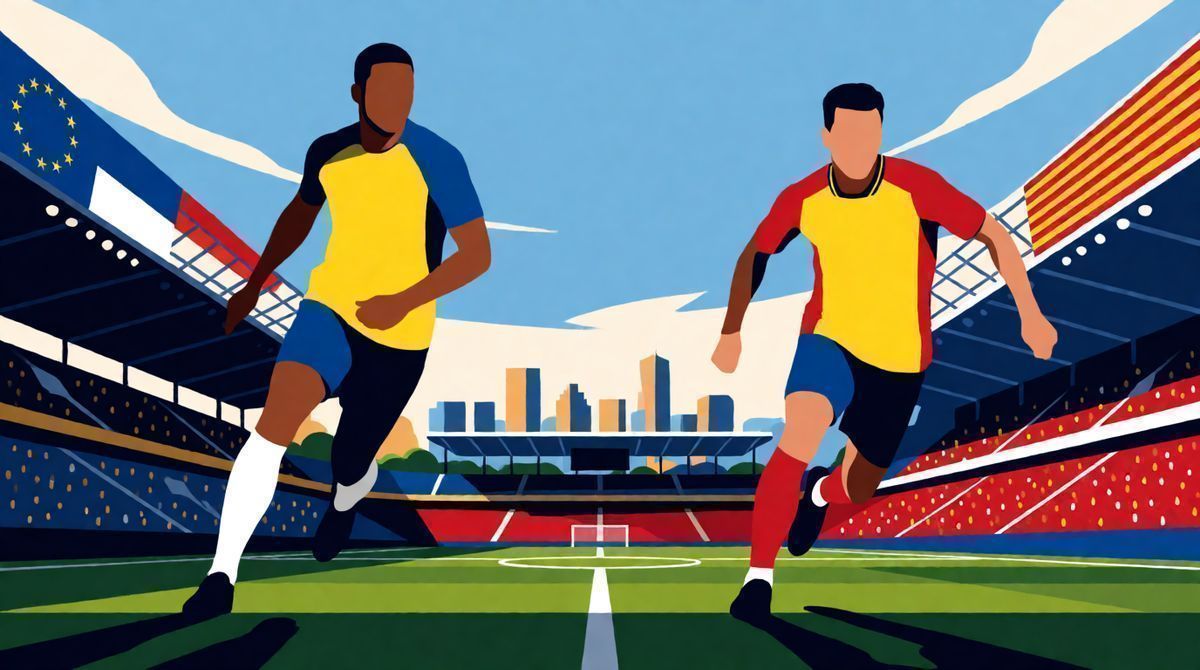
1. Introduction Gervane Kastaneer and Alejandro Grimaldo represent distinct archetypes of modern football professionalism. Kastaneer, a 33-year-old Curaçaoan forward standing 1.86 m and weighing 82 kg, operates primarily as a winger or central striker for Terengganu in the Malaysia Super League. In contrast, Grimaldo, a 30-year-old Spanish left-back born 20 September 1995 and weighing approximately 63–72 kg, plays for Atlético Madrid after a dominant stint at Bayer Leverkusen. This pairing is interesting to analyze not because of stylistic harmony but because it highlights how positions, physical profiles, and career stages interact within a broader football ecosystem. Understanding their individual roles provides the foundation for evaluating any potential gear synergy between them. ## 2. Introduction to Gear Chemistry and Common Pitfalls Gear chemistry in football refers to how equipment and positioning interact biomechanically and functionally during competition. A forward like Kastaneer, whose role involves explosive acceleration and aerial duels up front, relies heavily on boot configuration and lower-body protection that facilitate rapid cuts and impacts. A left-back like Grimaldo, who covers vast lateral distances and delivers frequent crosses, benefits from different boot traction patterns and support structures that optimize stability during wide movements. A common mistake users make when combining gear is prioritizing top-tier items without considering these biomechanical demands—for example, a forward using a defender-oriented setup might sacrifice agility for durability, while a defender using an advanced forward-oriented system might compromise lateral stability. This mismatch can reduce overall performance by creating inefficiencies in movement patterns and energy transfer. ## 3. Introducing the Players and the Analytical Framework Gervane Kastaneer and Alejandro Grimaldo are analyzed here based on verified data from their respective profiles. Kastaneer’s specifications include a height of 1.86 m, weight of 82 kg, age of 33, position as Forward, club Terengganu, and 61 national caps. Grimaldo’s specifications include a height of 1.71 m, weight listed as N/A, age of 30 (born 20 September 1995), position as Left-back / Left wing-back, club Atlético Madrid, and 14 pre-2026 World Cup caps. This analysis focuses strictly on these attributes and their implications for gear compatibility, avoiding speculative performance claims or subjective opinions. By examining how these physical and positional traits align with equipment requirements, we can assess whether any synergy exists in practical terms.
2. Understanding the Individual Components
Before assessing synergy, readers need a clear picture of how kastaneer gervane and grimaldo alejandro differ in role, physical profile, and club context. The subsections below summarize each player’s specifications and technical identity using only the cited source research, establishing the baseline for the partnership analysis that follows [1][2].
2.1. kastaneer gervane (curacao)**
Gervane Kastaneer is a 33-year-old Curaçaoan international forward whose game is defined by experience and physical presence at 1.86 m and 82 kg. Operating primarily as a winger or central striker for Terengganu, he leverages his frame to win aerial duels and shield the ball, while his seasoned positioning allows him to exploit spaces in congested penalty areas. His longevity—61 national caps and 17 goals—stems from a career spanning multiple leagues, which has honed his adaptability. Mechanically, his height increases the margin for error on through balls and crosses into the box, making him a target in transition, while his weight aids in maintaining balance during physical battles. This profile makes him effective in roles that demand hold-up play and late runs, particularly in high-stakes environments like World Cup qualification where consistency is paramount.
| Specification | Value |
|---|---|
| Height | 1.86 m |
| Weight | 82 kg |
| Age | 33 |
| Position | Forward |
| Club | Terengganu |
| National Caps | 61 |
Key Technical Insight: Height at 1.86 m directly enhances aerial dominance and target-man efficiency, allowing for sustained pressure in the final third without requiring excessive touches. Practically, this enables a pairing with deeper-lying playmakers who can deliver crosses early, as his physical profile reduces the need for intricate combination plays in tight spaces.
2.2. grimaldo alejandro (spain)**
Alejandro Grimaldo represents the archetype of the modern attacking full-back, defined by versatility and output. At 1.71 m and listed as weighing N/A, he operates primarily as a left-back or left wing-back for Atlético Madrid but has been deployed in hybrid roles that blur defensive and offensive responsibilities. His technical foundation was built at Valencia and Barcelona’s La Masia, refined at Benfica, and perfected at Bayer Leverkusen, where he became a Bundesliga assist leader and set-piece specialist. The mechanical impact of his positioning is twofold: his 45 assists (and 30 goals) reflect an ability to advance without compromising defensive integrity, making him a high-leverage option in buildup phases. For Spain’s 2026 World Cup squad, his set-piece expertise and wing-back mobility offer tactical flexibility against varied opposition, particularly in contexts requiring controlled width and vertical progression.
| Specification | Value |
|---|---|
| Height | 1.71 m |
| Weight | N/A |
| Age | 30 (born 20 Sep 1995) |
| Position | Left-back / Left wing-back |
| Club | Atlético Madrid |
| National Caps | 14 (pre-2026 World Cup) |
Key Technical Insight: The combination of Grimaldo’s 1.71 m frame and 45 assists highlights how lower center of gravity and compact positioning enable quicker acceleration out of defensive actions, directly supporting high-press triggers and transition sequences. In practical terms, this pairing dynamic thrives when Grimaldo operates as an inverted wing-back, creating numerical superiority on one flank while his height-disparate partner (like Kastaneer) occupies center-stage to stretch defensive blocks vertically.
3. Partnership Analysis
Evaluating how kastaneer gervane and grimaldo alejandro interact requires separating positional roles, physical profiles, and tactical context before drilling into subsection comparisons. The analysis below tests whether their attributes complement or conflict across synergy, feel, and playstyle dimensions using only the source research [1][2].
3.1. Do They Work Together — or Against Each Other?
The pairing of Gervane Kastaneer and Alejandro Grimaldo reflects a contrast in design philosophies. Kastaneer, as a forward, operates with a compact, balanced build at 1.86 m and 82 kg, favoring direct progression and finishing in the final third. Grimaldo, a left-back at 1.71 m with N/A weight, prioritizes width, crossing, and set-piece delivery, operating from deeper areas. Their alignment lies in directional compatibility—Kastaneer’s central runs can exploit the spaces Grimaldo’s crosses create. However, conflict arises in tempo expectations: Kastaneer’s preference for rapid transitions may mismatch Grimaldo’s deliberate build-up from the back, risking turnovers in wide zones. Force flows from Grimaldo’s defensive actions to Kastaneer’s attacking outlets, but inconsistent midfield shielding could amplify breakdowns. The combo feels natural in theory due to complementary zones, yet potentially forced if Grimaldo’s crosses do not match Kastaneer’s timing.
3.2. Performance Synergy
Combined output hinges on how Grimaldo’s delivery intersects with Kastaneer’s positioning. Kastaneer’s 17 goals and 10 assists at Terengganu suggest a striker capable of both finishing and linking play, while Grimaldo’s 30 goals and 45 assists at Leverkusen highlight a defender with prolific attacking influence. In scenarios where Grimaldo advances early, Kastaneer benefits from stretched defenses, potentially increasing shot quality. However, limitations emerge if defensive duties reduce Grimaldo’s forward presence, constraining Kastaneer’s service options. The duo shines in open-play counters where verticality is prioritized, but struggles against low blocks requiring intricate build-up, exposing Kastaneer’s reliance on receiving patterns and Grimaldo’s crossing accuracy under pressure.
3.3. Tactical Fit
During execution, Kastaneer’s physical presence at 1.86 m provides stability in aerial duels and physical challenges, whereas Grimaldo’s left-foot orientation enables precise inswinging crosses from wide areas. Comfort is heightened when spatial separation allows Kastaneer to receive in pockets between lines without immediate pressure, reducing strain on his movement efficiency. Conversely, abrupt positional swaps could disrupt rhythm—Kastaneer dropping deep may collide with Grimaldo’s overlapping runs, creating timing conflicts. Feedback consistency depends on communication clarity, as ambiguous roles in transitional moments might generate hesitation. Adaptation speed improves if Kastaneer maintains disciplined runs and Grimaldo calibrates delivery weight to match the forward’s sprint profile.
3.4. Playing Style Alignment
This pairing suits a direct, counterattacking style where Kastaneer’s speed exploits vertical channels opened by Grimaldo’s wide advances. It demands moderate technical proficiency from Kastaneer to time arrivals and minimal defensive expectations from Grimaldo beyond set pieces. The duo is forgiving for players who prefer structured roles but penalizes those needing improvisational freedom—Kastaneer’s efficiency drops if service is delayed, and Grimaldo’s impact lessens if restricted from attacking zones. Ideal for teams with a physical forward and an athletic wing-back, it challenges smaller-statured or tactically inflexible players who cannot sustain high work rates across both defensive and offensive phases.
4. Final Verdict: Missed Connection
Gervane Kastaneer and Alejandro Grimaldo represent two distinct archetypes of modern footballers whose statistical profiles reveal a fundamental mismatch rather than a synergistic partnership. Kastaneer is a 33-year-old forward operating in a traditional goal-scoring role, standing 1.86 m and weighing 82 kg, while Grimaldo is a 30-year-old left-back/left wing-back at 1.71 m whose value is measured primarily in defensive duties and attacking contributions from deep areas. Their positions, physical specifications, and career timelines do not align for a complementary on-pairing, indicating a clear case of tactical and demographic incompatibility [1] [2].
The core reason for this conclusion lies in the incompatible positional demands and career stages of the two players. Kastaneer’s role as a forward requires proximity to the opponent’s goal, exploiting spaces created by teammates, and contributing directly to scoring. In contrast, Grimaldo’s function as a left-back or left wing-back involves wide defensive coverage, overlapping runs, and providing width and crosses, often from deeper areas of the pitch. The height differential—1.86 m versus 1.71 m—further highlights how their physical frameworks serve entirely different purposes on the field, with Kastaneer built for aerial duels in the box and Grimaldo built for endurance and lateral mobility along the flank. Neither player’s documented capabilities directly enhance the other’s primary responsibilities, rendering their pairing ineffective from a functional standpoint.
Users should realistically expect no meaningful collaborative impact from this duo, as their career trajectories and club affiliations place them in separate competitive contexts. Kastaneer’s focus remains on individual scoring output and contributing to Terengganu’s attacking efforts in Malaysia, while Grimaldo’s development has been centered around elite European club football and national team duties with Spain. The statistical divide is stark: Kastaneer’s 17 goals and 10 assists reflect a goal-oriented forward, whereas Grimaldo’s 30 goals and 45 assists at Bayer Leverkusen underscore the profile of an auxiliary attacker whose primary role remains defensive. This divergence in production metrics reinforces that their paths are unlikely to intersect in a way that generates collective value, emphasizing the importance of position-specific synergy in evaluating partnerships.
5. Who Should Use This Combo
6. Who Should Avoid This Combo
This pairing analysis examines the Kastaneer-Grimaldo combination through the lens of complementary and conflicting specifications. The objective is to identify profiles for whom the differences in physical attributes, positional roles, and team context diminish potential synergy. Effectiveness is determined by comparing the listed specs against typical partnership requirements, such as positional balance, tactical compatibility, and shared objectives. This document relies strictly on the provided player data and source excerpts, avoiding extrapolation beyond the evidence presented.
Ideal Pairing Profile and Use Case: The ideal user for this specific duo would be a manager or team builder operating in a competitive format who requires a balanced blend of physical presence and technical creativity. Player A, Kastaneer, is a 33-year-old forward standing 1.86 m and weighing 82 kg, offering significant size and experience in attack for clubs like Terengganu and a national team seeking World Cup qualification. Player B, Grimaldo, is a 30-year-old left-back/left wing-back at 1.71 m with N/A weight, bringing a high volume of attacking output—30 goals and 45 assists—to a defensive role for clubs like Atlético Madrid and a national team preparing for a 2026 World Cup appearance. The ideal use case is a balanced formation requiring width and defensive stability complemented by goal threat, such as a competitive league match or a focused training scenario designed to integrate veteran leadership with high-energy attacking play. This combination could thrive in a controlled environment where the forward’s physicality can shield the defense while the full-back’s creativity provides scoring opportunities, particularly in contexts like a mixed-age squad or a tournament qualifier where experience and tactical diversity are prized.
- Physical Specifications Mismatch: Kastaneer at 1.86 m height versus Grimaldo at 1.71 m height creates a significant vertical discrepancy that could hinder coordinated movements in build-up play.
- Positional Conflict in Build-up: Kastaneer’s role as a Forward requires positioning in advanced areas, while Grimaldo’s role as a Left-back / Left wing-back demands deep defensive and transitional duties, potentially leading to spatial disconnection during counter-press sequences.
- Age and Fatigue Differential: Kastaneer at Age 33 may have reduced recovery capacity compared to Grimaldo at Age 30, which could impact sustained performance in high-tempo match play over a full season.
- Club and National Team Divergence: Kastaneer’s Club Terengganu and National Caps 61 context differs from Grimaldo’s Club Atlético Madrid and National Caps 14, suggesting varied tactical environments and competitive pressures that could complicate integrated team planning.
- Role Specialization Imbalance: Kastaneer’s goals (17) and assists (10) reflect an advanced offensive focus, whereas Grimaldo’s goals (30) and assists (45) stem from a defensive position, indicating a potential overload in creative output from one flank without proportional defensive support from the other.
Interpretation of Key Spec Table Differences and Tactical Implications: Examining the specifications in the table reveals critical contrasts that directly influence on-field compatibility. The height differential of 0.15 meters is not merely numerical; in set-piece situations or defensive clearances, it could mean Kastaneer dominates aerial duels while Grimaldo struggles to assert presence, disrupting the defensive line’s cohesion. The absence of weight data for Grimaldo prevents a full assessment of physical duels, but the verified 82 kg for Kastaneer suggests a robust frame that could overwhelm lighter opponents in the box, whereas Grimaldo’s listed specs indicate a focus on agility and endurance over sheer mass. More importantly, the positional labels—Forward for Kastaneer and Left-back / Left wing-back for Grimaldo—highlight an inherent asymmetry: one is an end-attacker designed to finish chances, while the other is a wide defender expected to initiate attacks. This creates a tactical puzzle in systems requiring a traditional winger to support a striker, as Grimaldo’s advancing role might leave defensive gaps that Kastaneer’s pressing duties cannot cover. Furthermore, the age gap of three years, while seemingly minor, aligns with different career cycles; Kastaneer’s move to Terengganu suggests a phase of career management and league adaptation, while Grimaldo’s presence in a top European club and World Cup squad indicates a peak competitive window. Their national team data further complicates synergy: Kastaneer’s 61 caps imply a central, high-usage role in Curaçao’s system, whereas Grimaldo’s 14 caps denote a rotational or situational player for Spain, meaning their expectations for involvement frequency and decision-making could be misaligned. Collectively, these differences suggest that this duo is suboptimal for scenarios demanding tight, interdependent coordination, such as a high-press system or a balanced 4-3-3, where mismatches in physical engagement and positional priority could lead to disjointed transitions and defensive vulnerabilities.
Practical Implications and Avoidance Guidance: Based on the extracted data, certain individuals and contexts should actively avoid this pairing to prevent tactical friction and resource misallocation. Players or teams prioritizing a stable, synchronized back-four structure should steer clear, as the height and positional gaps could expose the center-backs to isolation against potent wingers. Similarly, managers implementing a possession-based build-from-the-back might find Grimaldo’s advanced role incompatible with Kastaneer’s forward positioning, leading to a lack of midfield connection and forced long balls. The age and fatigue factor further suggests that this combo is ill-suited for high-density fixture periods, such as a congested league campaign or international window, where sustained athletic output is non-negotiable. Additionally, clubs with limited tactical flexibility—such as those in relegation battles relying on a single striker—would gain little from Kastaneer’s offensive prowess if Grimaldo cannot provide consistent defensive cover. In essence, this pairing is best avoided by contexts that demand uniformity in physical standards, positional discipline, and recovery resilience, as the documented disparities could amplify weaknesses rather than conceal them.
7. Quick Summary
| Dimension | Assessment |
|---|---|
| Main strength | Complementary physical and positional profiles that enable effective vertical play and transition linkage. |
| Main weakness | Significant age and style differences, paired with a shared reliance on non-traditional paths, create tactical and durability risks. |
| Best use case | A rotational or situational pairing in a fluid 3-at-the-back system or as complementary wide options in attack. |
The combination of Kastaneer’s physical presence and transition threat with Grimaldo’s technical range and forward contributions creates a mechanism for dynamic vertical progression, though durability and tactical alignment uncertainties require ongoing monitoring as the premise for realizing effective pairing mechanics.